The double that stunned even Rose Davies herself

Rose Davies’ 5000m and 10,000m double contributed to Australia’s impressive Commonwealth Games showing in Glasgow. She talks about being able to back, seize her opportunity and be part of her country’s growing strength.
It was on the train heading out of Glasgow that Rose Davies sat back and began to really absorb what had just happened to her. The Australian, who bases herself in Teddington, London for the European summer, was heading back south with two very valuable items in her luggage – Commonwealth 5000m and 10,000m gold.
Given that there was a point earlier in the year when she was concerned about even making the team, putting herself on the top step of the podium – twice – was a result that hadn’t been entirely expected. But, on the Scotstoun track, Davies excelled.
On an opening night when the majority of the crowd had come to cheer on Scotland’s defending champion Eilish McColgan and medal hopeful Megan Keith, it was the 26-year-old who instead experienced her own moment of magic.
McColgan ultimately didn’t make the start line, while Keith finished ninth, but Davies held her nerve after the pedestrian first half, hunted down breakaway leader Diana Wanza and then overtook the Kenyan with about 600m remaining to become Australia’s first ever winner of the women’s 10,000m at the Commonwealth Games.
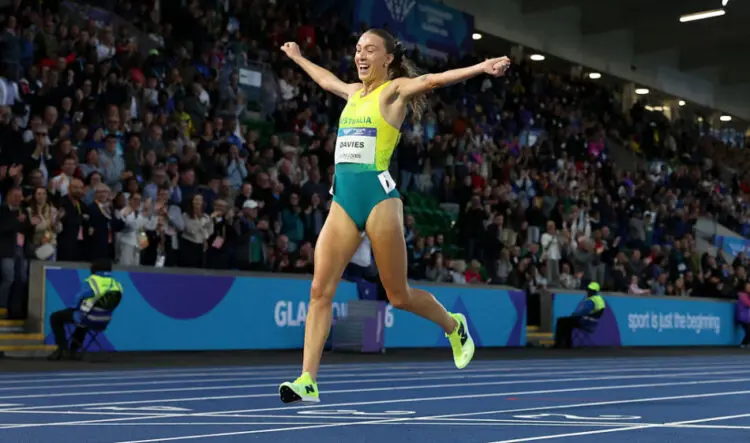
Despite feeling “pretty beaten up”, Davies was back in action in the 5000m and, again it was Keith who attracted much of the attention – especially when, with four laps to go, the Scot decided to hit the front and make the long run for home. But she was tracked ominously by Davies and Jessica Hull, with the Australian duo eventually closing the gap and moving ahead with only around 200m remaining to fight it out for gold.
Davies won the sprint finish against the Olympic 1500m silver medallist, becoming the first woman ever to complete the 5000m and 10,000m double at a Commonwealth Games. Her winning time was 14:44.53 to edge Hull (14:45.01).
“I was thinking: ‘Whoa, that was kind of crazy’,” she says of that post-championships train journey. “There was a lot of pride, and I exceeded my expectations to the max. If you had told me at the start of the year that I would win gold in both events I probably wouldn't have believed you. At the start of the year, I didn't think I'd even make the team.
“Last year, I had a few hiccups. Nothing injurywise but I had to get my appendix out and I was really sick from that. There were a few other things healthwise and it took me a while to get my fitness back.
“The Australian Champs is part of the selection process and I just felt like I was scrambling before it to get myself right, and the field was so competitive. I came fourth and I thought it put me on the back burner a little bit so I knew ‘The only way to make the team now is to run fast’, and I ran okay.
“I think our qualifying was 14:55, and I ran 14:53.28 at the Diamond League [in China] and I was like: ‘I hope that's enough to make the team’. Luckily it was. Once I found out I was on the team, I was able to switch my focus and get into training, get fit and sharpen up. It came together, which I'm very grateful for.”
The training process worked perfectly for Davies, who hails from Newcastle, New South Wales. At home she has worked with coach Scott Westcott for the past 10 years and, when she’s overseas, her training is watched over by Nic Bideau – one of the driving forces behind Australia’s impressive Commonwealth success.
“I put a lot of pressure on myself to run well because I know what I'm capable of,” she adds. “I wanted to show to myself: ‘I'm fit and I can still compete with the best’. Every race I had this year put me a step forward towards that.”
And so to Glasgow. It’s one thing to make the team but to attempt, and then complete, the distance double is quite another.
“It's the first time I've ever doubled, too,” says Davies. “I thought the Commonwealth Games would be such a good opportunity to practice doing the double, especially because you don't have heats in the 5000m, so it just takes a little bit of pressure off.
“I was so unsure on how it would go, especially given that I don't race 10,000m very often and the last one I’d done was at the Oslo Diamond League last year. And that [10,000m final] was a really, really hard race. I was pretty beaten up from it, but I had such a strong training block leading into the Games, and I knew I was strong and I knew I was fit.
“To win the 10,000m, I think I was in shock, to be honest. We ran a 14:48 last 5000m and I was tired after the race, but I've just been able to recover so well and that really helped me refocus for the 5000m. I knew that my body would be able to handle it, and I'm grateful it did.”
Davies also admits to feeling a debt of gratitude to Keith, for deciding to speed things up and string the field out during that 5000m final.
“I was thinking: ‘Everyone's capable of finishing so fast’, so I needed it a little bit quicker because we weren't running too fast. I did say thank you to Megan after that because I was thinking: ‘Oh god, I might have to take it up myself’. It just helped string out the race and, two laps into her surge, I looked up and saw that I was in the top three. I was like: ‘Okay, I think it's a medal from here, but which colour?’.”
To win, she would have to overcome Hull, a fellow countrywoman who is no stranger to winning big races and major medals.
“Jess is such an amazing athlete, she's so fast and to be in a sprint finish with the Olympic silver medallist is not the position you want to be in,” adds Davies. “But I just had to really trust my kick and believe that I could do it.
“Coming off the final bend, she came up on to my shoulder, and I just dug as deep as I could, trying to unlock the speed that I knew I had in there. But it was very nerve wracking. I just had to really trust my speed, and I've been focusing on practicing my finish, so I guess it's just muscle memory.”
Davies’ double contributed to Australia’s final tally of 34 athletics medals in Glasgow – 12 gold, 11 silver and 11 bronze. That equalled the most that the nation has ever won at a Commonwealth Games outside of Australia. By bringing an incredibly strong team with them to Scotland, it was clear that this was a country taking the Games, stripped back or not, extremely seriously and they were able to demonstrate the depth of talent across a range of events.
Men’s 10,000m champion Ky Robinson very nearly emulated Davies’ double, coming second in the 5000m, Lachie Kennedy broke the Oceania record with silver in the 100m, Cam Myers finished second to Josh Kerr in the men’s mile, while Abbey Caldwell led a clean sweep of the medals in the women’s mile and both 10,000m race walking gold medals went Australia’s way too. In the field, Kurtis Marschall won the men’s pole vault for a third time, Matt Denny won the discus and Eleanor Patterson landed high jump gold after fighting it out for the title with compatriot Nicola Olyslagers on a night of torrential rain and high drama.
“They did such a great job [in Glasgow],” says Davies. “It's such a great championships as a stepping stone for championships like the Olympics and it also shows just how good Australian running is going.
“Everyone's firing in every event, and for most people to come out, run their best and get a medal out of that is just incredible. It just shows where we're at as a nation. The momentum is growing – watch this space in a few years.”
Davies is now turning her attention to the final tasks on her to do list this season. There are Diamond Leagues to run, a possible appearance at the Ultimate Championship in Budapest and she will also extend her time in Europe to compete at the World Road Running Championships in Copenhagen, also being staged next month. She is clearly beginning to thrive as a senior, having once made headlines by showing her athletic promise in her early teens over 800m and 1500m.
“I won nationals when I was 13 or something like that and I was always top three in Australia,” she says. “I was a really dedicated kid, almost too dedicated, and it put me out of the sport for a bit.”
The now 26-year-old developed a hip problem that put her out of action for two years but, now, she sees that enforced break as a blessing.
“I don't think the hip problem was major,” she says. “I think it was just classic teenage junior prodigy trained too hard that needed a break. But I do think having a break helped me when I did transition into seniors. I came with the newfound drives and almost a freshness. It's helped me be the athlete I am now.
“I just don't think success happens overnight, and I don't think that I'm there yet. But I do think, slowly but surely, you get there. You’ve just got to keep at it.”