Sub-two: From rough diamond to record-breaker

Colin Thomas, a former coach to Sabastian Sawe, talks about how the Kenyan has been able to build on natural talent and ink his name into the history books.
It was time to go hunting for clues. A few days after the athlete he once coached had changed the face of distance running forever – and with his curiosity piqued – Colin Thomas decided to delve into his personal archive.
As one of the many people who have been trying to fully comprehend 1:59:30, the Scot’s head was full not just of questions but memories that he wanted to refresh. He recalls a trip to Kenya in 2018 and meeting a young man in early twenties who was “quite smartly dressed, with black smart shoes on, jeans and a blue t-shirt. He didn't really look like an athlete”. That young man was Sabastian Sawe.
This time last year, the pages of this magazine featured an interview with Thomas, who is based in Glasgow but whose coaching journey has regularly taken him to Iten. Working with fellow coach John Ewoi, he was there eight years ago to help establish and train a group of eight athletes for whom he had sourced second-hand kit and found accommodation. The self-funded project was halted by Covid in 2020 but it most certainly left its mark.
When Sawe won London for the first time in 2025, he and Thomas enjoyed a brief reunion to celebrate a landmark moment in the Kenyan’s career. They were able to meet again in April, but on this occasion the 31-year-old had done a great deal more than “just” winning another major marathon.
“He looked like he could have gone and done it again,” smiles Thomas, remembering their post-race meeting. “He didn't seem tired or fatigued. He's not one for celebrating and putting himself out there. He was just very quiet. Introverted. Withheld. We had a very simple chat and I just congratulated him on what he had done. I don't think it had really sunk in with him. He was so neutral about it – emotionless, almost. I don't think he had realised the extent of it and I think partly that's a Kenyan thing, because they've got so much belief in themselves that they just think: ‘I can do anything’. To him, I don't think it was really that much of a big deal.”
That isn’t how the wider world has been viewing it. The performance has been pored over and marvelled at, while the self-critical part of Thomas’s brain has been asking why Sawe might not have necessarily stood out during their early encounters back in Kenya. That, and simply wanting to strengthen the memory of those days, is what sparked his own wander down memory lane.
“I was looking at an old laptop and found one of the track sessions [from before],” says Thomas. “I got somebody to come down with a proper camera and film it, which I'm glad I did now. We were doing a session of 20 x 400m reps, starting off at 65 seconds and getting quicker and quicker. The last ones were down at 62 seconds and it’s noticeable how comfortable [Sabastian] looks. Some of the other guys in the group are just hanging on and he's comfortable. He's almost jogging.
“When you look at that, you can see the potential. You wouldn't have deemed him as being a proper runner in those days. He was quite new to it, but I think that's what shows the natural talent that he has. Scientists have always said it takes eight years to build a proper marathon runner – so, if you think about it, 2018 to 2026 [is about right].”
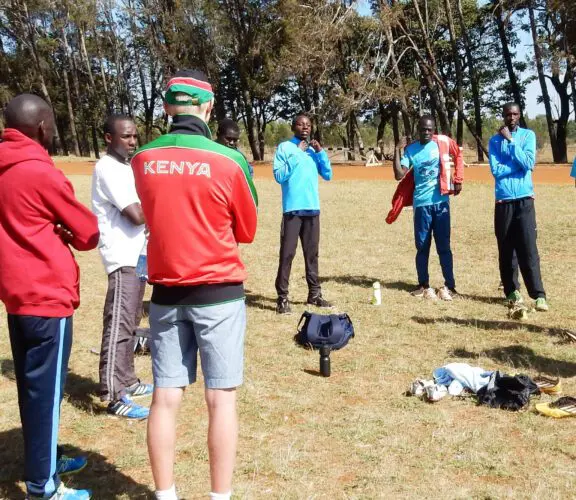
He goes on. “We did a lot of speed training with them, too. I've got videos of the group doing simple high knees drills, high knee skips – the stuff you do with any young athletes – then getting them to sprint flat out for around 60m. I was looking at those videos and again you can just see how smooth he is covering the ground. The potential was there, without any training, to do something amazing. I just wish I'd seen more of it!
“I sometimes think: ‘Why did we not see how good he was back then?’. But it's easy to overlook it because there's so much talent [in Kenya]. There are so many of them that are talented and could do amazing, amazing things, that the idea of ‘he's going to break two hours’ would never have crossed my mind. And at the time, that wasn't really the aim. For myself and John, the aim always was to give these people opportunities and that's what we did.”
That opportunity helped set Sawe on the path to where he is now and Thomas can’t wait to see what comes next, in Berlin this autumn, though he does sound a note of caution about the workload of an athlete who overcame a stress fracture in his foot and a back issue in the run-up to London.
“[Sabastian has] already made a big jump and he’s run four marathons in 18 months, which is a lot,” says Thomas of a marathon career which began in Valencia in December of 2024. “We don't know what impact that's going to have on his body. I guess we'll soon find out if it's too much and I hope he's not taken advantage of, because there are people that want to make a lot of money out of him. I hope that they give him a break and remember that he's a human. He's not a robot. To me, there's no way he'll handle another four in the next 18 months. It’s completely unreasonable to think that he will.”
What remains certain is the impact that the evolution of elite marathon running is having on the wider sport. Thomas coaches athletes of all levels and he can see the advances in speed, shoes and nutrition all beginning to trickle down to more recreational runners.
“Everybody wants to get more and more technical about it, probably too much,” he says with a rueful grin. “Honestly, the number of people that are testing their blood lactate levels, for instance. Why are you doing that when you only run three to five times a week? You don't need to be stabbing yourself to get quicker.
“They're just copying things they see, because information is at our fingertips, but we're just overloaded with it. It's about picking out the gems – and that's what we can get from elite athletes. We can pick out little nuggets to learn from. When you come back to normal people, it's just: ‘Do a little bit more training, get some decent sleep, eat some proper food…’.
It was those basics that served Sawe so well eight years ago and, as he looks back, there is a lingering feeling of pride for Thomas in having played a part in such a significant moment for the sport.
“We're in a new era of marathon running,” he nods. “There's no doubt about that.”
This article also appears in the Sub-two special edition of AW magazine, out now