A new global championship, a record prize pot and a Kerr-Ingebrigtsen showdown years in the making: your guide to the inaugural World Athletics Ultimate Championship in Budapest.
Josh Kerr and Jakob Ingebrigtsen will finally share a start line in a global 1500m final. Gianmarco Tamberi returns to the city where he became world champion. Mondo Duplantis has written the theme song. And for the first time in the sport's history, a field event will pay out $150,000 for gold with no medal to show for it.
Welcome to the World Athletics Ultimate Championship – a brand new, self-consciously disruptive addition to the athletics calendar that lands in Budapest next month. Here's everything you need to know before the sport's newest and richest event gets under way.
What actually is the Ultimate Championship?
The pitch from World Athletics is simple: settle, once and for all, who is the best of the best. Rather than qualifying via entry standards or national team selection, as with the Olympic Games or World Championships, admission to the Ultimate is earned purely through results – Olympic titles, world titles, Diamond League wins and end-of-season world rankings. There are no country quotas on individual events, so in theory an entire final could be made up of athletes from a single nation, though in practice depth of talent will spread things out.
It's billed as a biennial fixture, condensed into three evening sessions rather than the usual sprawling championship schedule, with the explicit goal of producing fields that can't be second-guessed. As World Athletics President Sebastian Coe put it when announcing the format: "We have said from the very beginning that we are doing things differently with the Ultimate Championship."
When and where
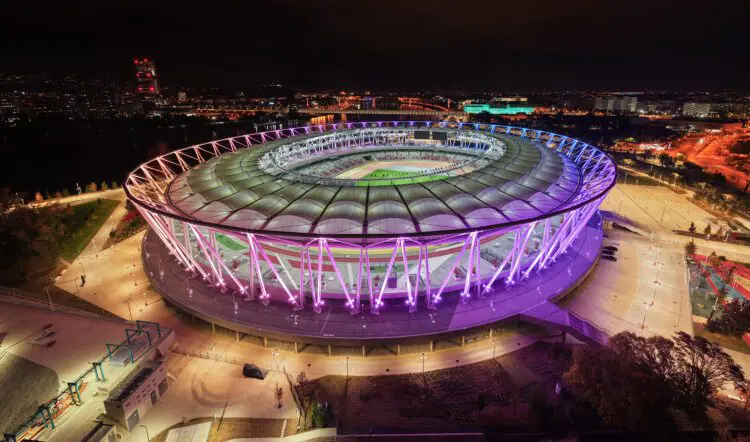
The championship runs from Friday, September 11 to Sunday, September 13, at the National Athletics Centre in Budapest – the same stadium that hosted the 2023 World Championships. Each of the three sessions lasts three hours and is built around a show script rather than a conventional timetable, with organisers designing the running order so that, wherever possible, only one field event is under way at any given time.
Twenty-eight finals will be contested in total, across the standard track and field programme: the 100m, 200m, 400m, 800m, 1500m, 5000m, both hurdles events, and the mixed 4x100m and 4x400m relays, alongside the jumps and throws.
How the field gets picked
There are no entry standards at the Ultimate. Athletes earn their place one of four ways: by being a 2024 Olympic champion, a 2025 world champion, a winner of this year's Wanda Diamond League final in Brussels, or by their position in the world rankings across a qualification period running from September 2025 to September 1, 2026. Relay places work slightly differently – the top six teams from the 2026 World Relays in Gaborone secured automatic qualification, with the final two spots going to the best performances recorded across the ranking window.
On top of that, World Athletics has reserved a small number of exceptional invitations to fill gaps its own qualification system might otherwise miss – normally capped at one per discipline. It's this mechanism that has already produced the story of the build-up.
Because entries are confirmed only after the Diamond League final, the fields below aren't quite locked in yet – but the shape of the championship, and its headline clashes, are already clear.
The one everyone's waiting for: Kerr vs Ingebrigtsen
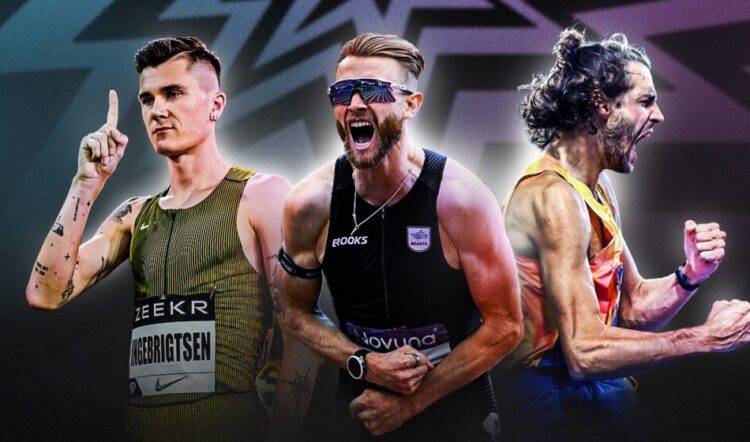
Josh Kerr and Jakob Ingebrigtsen have spent years exchanging words as freely as they've exchanged positions on a start line, but rarely in the same race when it has mattered most. That changes in Budapest. Both were confirmed for the men's 1500m via exceptional invitation – Kerr, Britain's 2023 world champion, arrives off the back of a mile world record of 3:42.66 set in London in July; Ingebrigtsen, the 2021 Olympic 1500m champion, already held an automatic invitation to the 5000m and will now double up in Budapest.
"I've made some choices this season that have created plenty of noise, but I've always wanted to prove myself in the biggest races, against the best in the world," said Kerr. "Budapest gives me another opportunity to do that, and I'm coming to compete for the win."
Ingebrigtsen was typically brief: "I love racing and I try to do as much as I can. I'm excited to run in Budapest!"
Their inclusion was significant enough that World Athletics expanded the 1500m field from 11 to 13 to accommodate both men – with prize money extended to a 13th-place finisher for the first time, in line with the $5000 payout used elsewhere in the field – rather than force a choice between them. It's a field that already includes Cole Hocker, the 2024 Olympic champion, and Isaac Nader, the 2025 world champion, meaning Budapest will assemble the reigning Olympic, world and world-record 1500m credentials in one race for the first time.
The other names to watch
Gianmarco Tamberi has also been confirmed by exceptional invitation, for the high jump – a event where he already has history in Budapest, having won his world title there in 2023. He arrives fresh from a fourth European Championships gold in Birmingham, clearing 2.32m.
"I have very fond memories of Budapest, where I won my World Championships title in 2023, and I cannot wait to go back to this amazing place," said Tamberi. "I hope everyone will come to watch the high jump on Sunday, because now, after the Europeans, the goal is to go all out on that day."
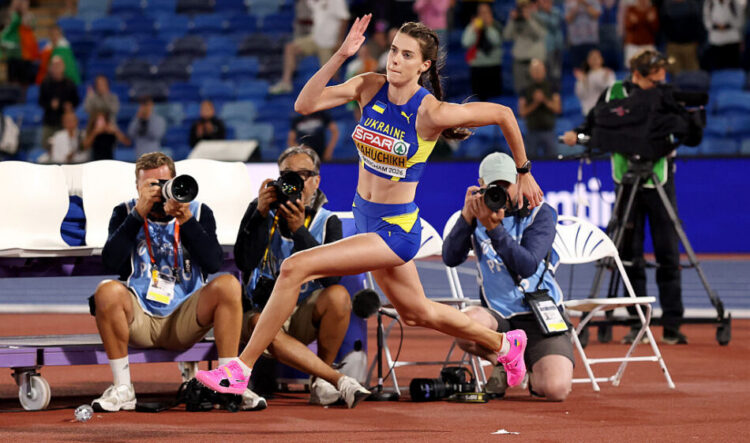
He won't be the only one with Budapest history. Yaroslava Mahuchikh, the world record-holder in the women's high jump, also won her world title in the city in 2023 before adding Olympic gold in Paris the following year. Asked to name her ultimate athlete ahead of her return, she picked Usain Bolt; her ultimate memory remains that gold in Paris.
Rai Benjamin, the three-time Olympic champion over 400m hurdles, is among those expected to headline the programme too, guided by coach Joanna Hayes, herself an Olympic 100m hurdles champion in Athens in 2004. "He's had so many injuries throughout his career," Hayes said of Benjamin. "The majority of championships, there's been something wrong with him but he just locks in."
Hungary's home invitations
As hosts, Hungary has been granted exceptional invitations of its own – four individual athletes and two relay teams, each guaranteed $1000 in prize money and added to their respective fields rather than replacing anyone already qualified: Patrik Enyingi (400m), Luca Kozák (100m hurdles), Sára Mátó (400m hurdles), Boglárka Takács (100m and 200m), and mixed 4x100m and 4x400m relay teams.
The money – and the absence of medals
The Ultimate carries the largest prize pot in the sport's history: $10 million in total, with $150,000 on offer for each individual champion. Every athlete who competes, not just those who win, is set to receive prize money.
In a break from convention, there won't be any medals. Instead, every invited athlete receives a participation token, with champions additionally awarded a trophy designed to physically connect with that token to form a single, completed piece.

A different kind of show
Much of the announcement around the Ultimate has focused on presentation rather than competition, and the changes are extensive. The infield will be almost entirely blacked out, with only the event in progress lit, to concentrate attention on one discipline at a time. There'll be no jury of appeal – athletes can lodge an immediate oral protest with the referee, or a written one within 30 minutes of results being confirmed – and ties for first place in the vertical jumps will be settled by a jump-off rather than shared. Field events will follow a new round-progression format, narrowing from eight athletes to eight, then six, then four across four rounds.
One of the more unusual innovations arrives before a single race is run. On September 10 – dubbed "The Day Before" – 200m competitors will publicly select their own semi-final heat and lane in world-ranking order, turning what's normally an anonymous administrative process into a live, televised event in its own right. The same afternoon also includes a press conference, a red carpet athlete arrival, a media day and a kids' athletics challenge fronted by Letsile Tebogo and Melissa Jefferson-Wooden.
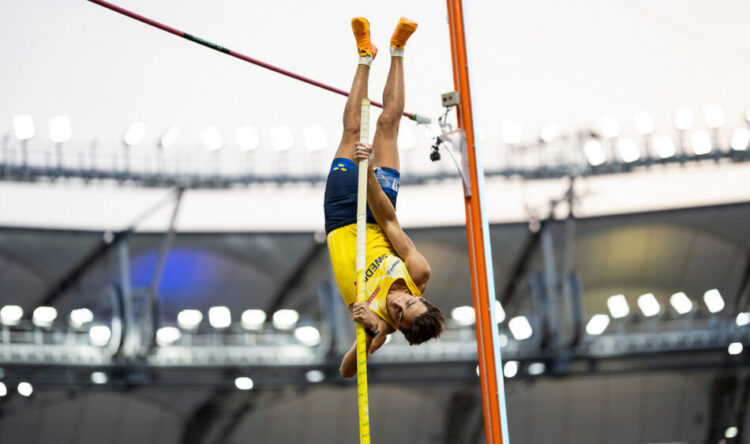
Mondo Duplantis, the pole vault world record-holder, has written and recorded the championship's official anthem, Gold, released globally alongside a music video filmed around Budapest. He'll perform it live in the stadium to close the championship on the Sunday evening. Duplantis and Noah Lyles both carry "Ultimate Star" billing and have helped shape elements of the athlete presentation and after-event experience, while Usain Bolt has been brought on board as the event's "Ultimate Legend."
How to watch
More than 20 broadcasters have signed up to show the Ultimate live, including the BBC in the UK, NBC Universal in the US and other major rights-holders across Europe, Japan and the Caribbean, with further deals still being finalised. A new World Athletics app, combining live results, athlete content and predictions, launches alongside the championship.
The bottom line
None of the fields above are final. World Athletics won't lock in the last invitations until after the Diamond League final in Brussels later this month – and the confirmed startlists will only take shape from there. But the framework – and the biggest storyline within it – is already set. In just over three weeks, Budapest will host the closest thing athletics has had to a genuine, no-excuses answer to the question of who is the best of the best. Kerr and Ingebrigtsen, for one, both sound ready to provide it.