Rock, Paper, Scissors settles elite race order for one-off Double TCS London Marathon

Catherine Debrunner beat Sabastian Sawe at Rock, Paper, Scissors to decide which day the elite women will race at the 2027 Double TCS London Marathon — a two-day expansion driven by record ballot demand that chief executive Hugh Brasher insists will be strictly "one and done".
The order of elite racing at next year's historic two-day London Marathon has been settled in unlikely fashion: a game of Rock, Paper, Scissors between two reigning champions and current world record-holders.
Sabastian Sawe, who became the first man to break the two-hour barrier for the marathon in London this year, went head-to-head with four-time London champion and women's wheelchair marathon world record-holder Catherine Debrunner to decide which day would open the 2027 Double TCS London Marathon.
Debrunner won, meaning the elite women's and women's wheelchair races will headline Sunday 25 April, with the men's equivalents on Saturday April 24. The contest, held in front of an official adjudicator, was ratified as a new Guinness World Records title — the first elite marathon start ever decided by Rock, Paper, Scissors.
The full schedule sees the men's wheelchair race, elite men, and male Championship and Good for Age runners race on the Saturday, while the women's wheelchair race, elite women, and female Championship and Good for Age runners follow on the Sunday. Mass-participation fields on both days will be mixed, open to male, female and non-binary runners. Entries for the Championship and Good for Age categories open on Thursday.
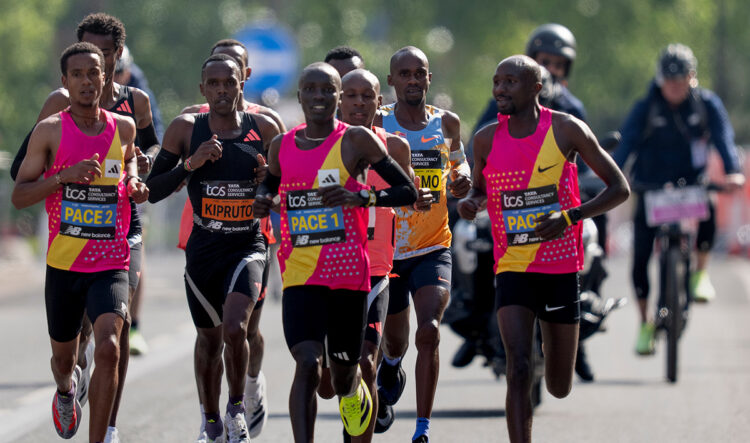
The switch to a two-day format is a response to unprecedented demand for places. A record 1.1 million people entered the ballot for this year's race, and that figure has since been surpassed by 1.33 million applications for 2027 — numbers organisers say the standard single-day event could never accommodate. The Double will allow a record 100,000 runners to take on the Greenwich-to-Westminster course, and London Marathon Events expects it to generate more than £150 million for charity, which it is billing as the biggest single fundraising moment in UK sporting history.
Brasher, chief executive of London Marathon Events, called the switch "a once-in-a-generation, one-time-only reimagining of what a marathon and city-wide celebration of activity can be." He was equally clear that it will not become a permanent fixture, describing 2027 as "a momentous one-off event" and adding: "The competition may not be quite so friendly when race weekend arrives!" Organisers' own event FAQs go further, stating plainly that this is "a one-off unique event for 2027 only" and ruling out any repeat in future years.
Brasher also framed the split as a positive for the women's race specifically, saying he was "particularly looking forward to the elite women's start on Sunday", when Championship-category women will for the first time line up behind the elite women's field rather than the men's, with the elite women's wheelchair race just ahead of them.
Whether "one and done" survives contact with reality is another question. Splitting the men's and women's elites removes the single shared global broadcast moment that has defined London's rivalry with the other five World Marathon Majors and running the course on consecutive days will test road-closure logistics, marshalling numbers and charity capacity in ways a single Sunday never has. But if the format delivers on its fundraising promise and proves manageable operationally, London would not be the first major event to find that a "one-off" experiment has a habit of quietly becoming the new normal — something organisers of the other five majors will be watching closely.