Issey Kyson taking barriers in her stride

We talk to a young athlete who is making a big impact away from the track.
On the track, 17-year-old Issey Kyson is a promising 400m and 400m hurdles athlete with county and national level medals. But it is off the track where she is truly making an impact, standing out as a rising star for very different reasons. While still building her athletics career, she has become a powerful advocate addressing the challenges that cause so many girls to leave sport during puberty. At just 15, she began filming a documentary exploring this issue, interviewing elite athletes, coaches, academics and policymakers.
Her efforts have led to the co-development of a national schools campaign and an accompanying toolkit, expected to reach over one million students and 20,000 PE teachers. She has also contributed to policy recommendations currently under consideration for the UK’s national curriculum, designed to improve understanding of puberty and its effects on young athletes’ performance.
As a Nike youth ambassador, Issey continues to use her platform to drive change and ensure that girls receive better support throughout their sporting journeys.

How did you become a hurdler?
I started aged nine, doing junior parkruns. One of the club coaches saw me and invited me to join. I started with cross country and did pretty well – I got a national silver at the Liverpool Cross Challenge.
Then I decided I wanted to do heptathlon because of Jessica Ennis-Hill. My dad showed me a replay of her at the 2012 Olympics, and I thought: “I want to be like her”. But I fell out with high jump and long jump. I had a bad experience in the high jump – I hit the upright, kicked a marshal, cut my leg and my dad had to scoop me off the track. I was just terrified after that.
I loved hurdles, though. I did sprint hurdles and long sprints for a while but, by under 15s and 17s, my coach said I had to pick one. The training for both didn’t match. So I chose long hurdles, the best of both worlds.
How did you first decide that you wanted to be an advocate for girls staying in sport?
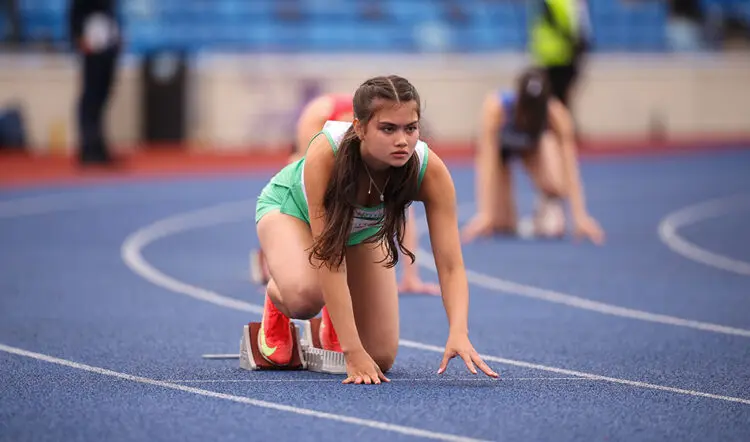
I was about 11 when I noticed loads of girls in the younger age group doing track and cross-country. It was mostly girls and one boy. But in the older groups – under 15s, under 17s – the girls had disappeared. That’s when I first noticed a difference in participation.
It wasn’t until I went through puberty that I realised why.
When I was 13, I gained six kilograms in six weeks. It slowed down my performance, even though I was training hard. I didn’t know it was a natural part of transitioning to a woman’s body – I just thought I got fat and slow.
I also started to feel self-conscious in my kit. I used to race in crop tops and shorts, but I began worrying about how I looked, like seeing my stomach roll. That made me uncomfortable at training and races.
Periods were another issue. The first time I got cramps was during a race warm-up. I didn’t know what it was. I told my dad I was in too much pain to race. Luckily, he found a sporty mum who reassured us that I could run, and I actually ended up winning that race.
All of that made me realise that no-one tells girls what to expect. If I hadn’t had support, I probably would have dropped out. That’s when I knew it needed to be addressed through education.
What have you done to advocate for it?
I thought the best way to help was to speak about my own experiences. I took part in Nike’s Women’s Hour twice – once with Paula Radcliffe and once with Katarina Johnson-Thompson, who was my childhood hero. That was amazing.
I’ve also posted a lot on Instagram – I’ve done a series where I talked about how puberty affected me and how I got through it.
I tried to start a petition on Change.org to change the education curriculum, but I didn’t get enough signatures so instead I started writing emails and handwritten letters to MPs and people in government to push for change.
And we’ve filmed a documentary called Out of the Race where I interview different people to understand how puberty affects girls in sport. For example, I spoke to Tanni Grey-Thompson and Jessica Ennis-Hill about why girls drop out. It’s done, we just don’t know where it’s going yet.
What have you observed in schools and sports organisations about how they address puberty’s impact on teenage girls?
We get taught the biological side – like the menstrual cycle, wider hips, mood changes and maybe a bit in well-being lessons. But no-one tells you how it affects you in sport or daily life. It’s surface level.
At first, I thought well-being lessons were the best place for it. When I was talking to the Conservative government, they said there was space in the curriculum and it looked like it would happen. Then the government changed, and it got shelved.
Later, through the Department for Education, I found the Association for PE. That’s when we had the idea to create a toolkit for PE teachers, because they’re the ones with young people in sport. So I thought that could be a better way to make change.
What would you say to other teenage girls thinking about dropping out of sport?
This is something KJT told me that stuck with me. We’re all on our own biological timelines, so our progress can’t be compared. Success looks different for everyone.
If you don’t compare yourself to others, you’re fine. But as soon as you start, that’s when doubts creep in. Just stay in your own lane.
Issey Kyson
Age: 17
Club: Woodford Green with Essex Ladies
Coach: Gladys Bird
Event: 400m hurdles
PB: 64.79