Diamond in the rough: how Conica keeps Lausanne's Diamond League meet among the fastest in the world

Founded in the same year as Athletissima, Swiss track specialist Conica has underpinned Lausanne's fast times since 1986. Meeting founder Jacky Delapierre and chief executive Julien Carrel explain how a new CHF 1.5m surface keeps Pontaise among the quickest venues on the Diamond League circuit.
The Danube is a strange place to talk about Swiss rock. But that's where this conversation properly got going — on a warm September morning on the banks of the famous river in Budapest, on the final day of the inaugural World Athletics Ultimate Championship, with two men who between them have shaped one of the great fixtures on the European athletics calendar for the best part of half a century.
Julien Carrel is the current chief executive of Athletissima, the Lausanne Diamond League meeting. Jacky Delapierre is the man who founded it in 1977 and ran it for decades afterwards — one of the most recognisable figures on the international circuit, still turning up to major events in his 70s to watch the sport he helped build a stage for. Carrel, technical and understated, spent his younger years as a volleyball player rather than an athlete. Delapierre, flamboyant and instantly at ease holding court, ran 800m for Switzerland as a junior international — 1:49 for the two laps, on cinder tracks that splashed underfoot when wet, in an era when nobody could have imagined the surfaces track and field competes on now.
It's that gap — between the cinder and dirt tracks of Delapierre's own racing days and the precision-engineered Conica surface now beneath the feet of the world's best athletes at Athletissima — that sits at the heart of this story.
A meeting and a track surface, born in the same year
There's a nice coincidence at the start of this relationship. Athletissima held its first edition in July 1977, at the Stade Pierre-de-Coubertin by Lake Geneva, with Delapierre – then a former international 800m runner rather than an administrator – as its driving force. That same year, more than 300 miles away in Schaffhausen, a Swiss company called Conica was founded, beginning what would become one of the most respected names in sports-surface engineering anywhere in the world.
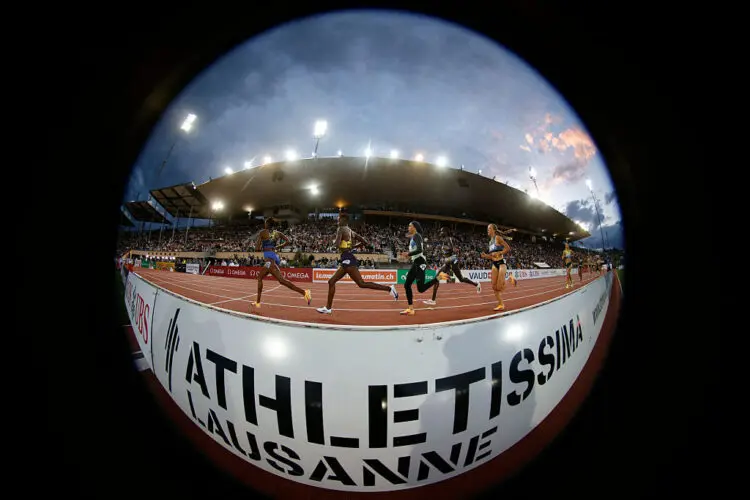
The two enterprises crossed paths for good in 1986 when the meeting outgrew its lakeside home and moved to the newly-rebuilt Pontaise Olympic Stadium – a venue with a story of its own. La Pontaise had originally been built for Lausanne's failed bid to host the 1960 Olympic Games; when the vote between Lausanne and Rome ended level, the International Olympic Committee's president cast the deciding vote for Rome, but allowed Lausanne to keep the "Stade Olympique" name regardless. Delapierre and his colleagues took the meeting there in 1986, just before the 1987 World Championships in Rome — Athletissima's first edition at Pontaise, in front of a crowd of 16,000, where competitors included Swiss distance runner Markus Ryffel and shot putter Werner Günthör – and the meeting has called the stadium home ever since.
From that point, the track underneath Athletissima has been a Conica surface throughout. “Conica has a long, very long history with us,” Delapierre explains.
It's partly a matter of loyalty, but mostly one of climate and engineering. Lausanne's seasonal temperature swings are extreme by track-surfacing standards — as low as minus 20 in winter, sweltering in summer — and Delapierre is quick to point out this isn't a knock on Conica's rivals, more a case of horses for courses. “It's not a problem of one company against another – we have a good relationship and friendship with the people at other companies too. It's just a problem of technique, of a product not being adapted to our conditions.”

Building on rock
Part of the Pontaise track's enduring reputation for speed and stability, Delapierre says, comes from what's underneath it. “The floor underneath is very hard rock — maybe two, four, sometimes 10 metres deep. That's one reason the track stays so stable.”
A significant technical upgrade came in 2003, when Conica closed the stadium to the public for a full resurfacing that introduced a variable-sized net between the surface's layers — denser around the pole vault and high jump run-ups, where pressures are greatest, and different again through the 100m start and first bend. At the time, Carrel notes, that was considered “a bit of a revolution” in track construction.
The most recent chapter came this year, ahead of the 2026 meeting. After two decades of service, the previous surface had deteriorated to the point of losing its World Athletics Class 1 certification — the top grade required to keep hosting Diamond League and major championship-standard athletics. “If you're a top meeting in the world and you don't have the top certification of the track,” Carrel says, “that's a no-brainer for us.”
The city funded a complete rebuild rather than a facelift of the surface — the whole track was torn up and replaced from scratch, at a cost of around CHF 1.5 million ($1.82m), in a process governed as much by chemistry as by construction schedules. Conica's engineers had to work within tight windows of temperature and humidity to lay and cure the new Conipur Vmax surface, at one point halting work altogether during an unusually humid spell in May. “There was always someone from Conica in charge during the whole process,” says Carrel on the six-week project, “supervising the mix, deciding when conditions were right.”
Conipur Vmax, Conica's current flagship track system, was developed with the German Sport University Cologne and combines an energy-reflecting base layer — with air cells that return energy to the runner after compression — with a stabilising top layer designed to reduce energy loss during the sprint phase. It's now the surface underpinning several of the world's leading Diamond League venues and Conica's biomechanical testing points to measurable reductions in energy loss compared with earlier-generation surfaces. For Delapierre and Carrel, the appeal is straightforward: a track engineered specifically to help athletes run fast, built by a company that has been solving exactly that problem, in precisely this climate, since Athletissima's earliest years.
What do the athletes say?
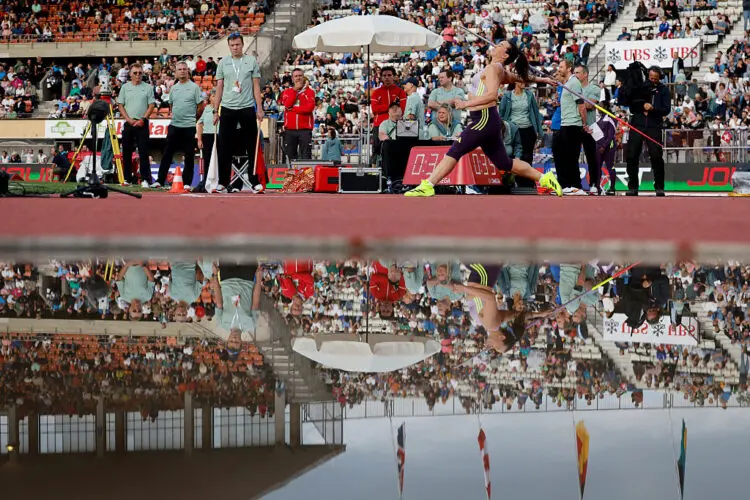
The proof, ultimately, lies with those who use the track at Pontaise. Few have offered more praise than Usain Bolt, a regular at Athletissima for more than a decade, who has called Lausanne “very special” and praised its bend specifically as “one of the best curves I have ever seen.”
Indeed, Bolt ran 19.58 in Lausanne shortly after the London Olympics in 2012, although Noah Lyles has run even faster in the Swiss city with 19.50 in 2019 and Yohan Blake clocked a swift 9.69 for 100m on the track in 2012 and another Jamaica, Shelly-Ann Fraser-Pryce, ran a blistering 10.60 in Lausanne for the women’s 100m in 2021.

Delapierre has a theory for why sprinters in particular love it: the stadium's original architect built the two bends to different specifications, meaning athletes in the outer lanes experience less centrifugal force. “That's why Usain Bolt always liked the outside lanes,” Delapierre says. “The best athletes' managers know to ask for it.”
After his 19.50 clocking, Lyles said: “The track here is burning up.” More recently, at the 2026 edition, Olympic 800m champion Emmanuel Wanyonyi – winner on the newly-laid surface – put it plainly: "I love competing at this Diamond League meeting in Lausanne because this stadium is one of the best for me. The track was very good, and the conditions were perfect."
Swiss hurdler Jason Joseph has said much the same after his own races there – "the track in Lausanne is fast" – a verdict echoed by sprinters and jumpers who return to Pontaise year after year.
Looking to the future
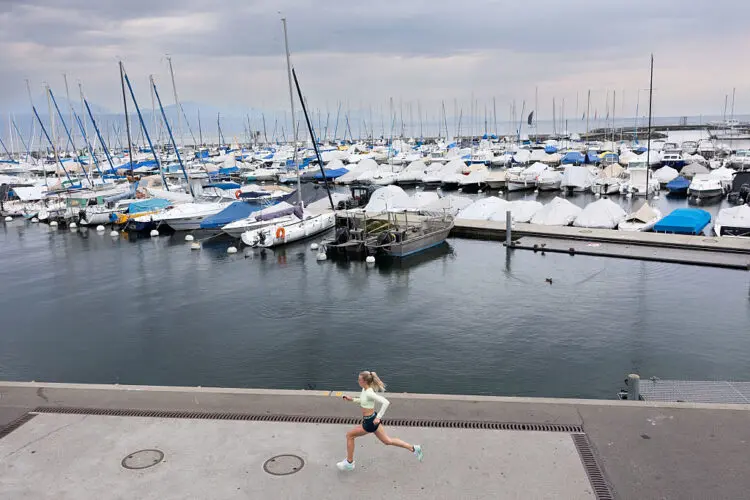
Athletissima's relationship with its track – and its city – is entering a new chapter. Within the next few years, the meeting is scheduled to move back to where it all began: a rebuilt Stade Pierre-de-Coubertin at Vidy, on the same lakeside site that hosted the first Athletissima in 1977.
“It's kind of going home,” Carrel says. The new stadium is planned with 12,000 permanent seats – expandable for meeting days – and unusually for a venue of its size, a six-lane, 100m indoor training track built into the main stand, intended to give Lausanne's athletics clubs a winter training base of their own for the first time because, of course, the facility is a busy venue used for athletics all year around and not just the annual Diamond League.
For Delapierre, who has spent almost 50 years building Athletissima from a fledgling meeting on that same patch of lakeside into one of the Diamond League's most respected fixtures, and for Carrel, tasked with carrying it into its next era, the story often returns the same two factors: a stadium bond with Lake Geneva that stretches back to the beginning and a Swiss track surface that has quietly underpinned the fast performances seen there since 1986.