Devynne Charlton: from indoor queen to outdoor contender

After setting herself apart over the 60m hurdles, Devynne Charlton has now set about proving that she can also excel over the longer discipline, writes Stuart Weir.
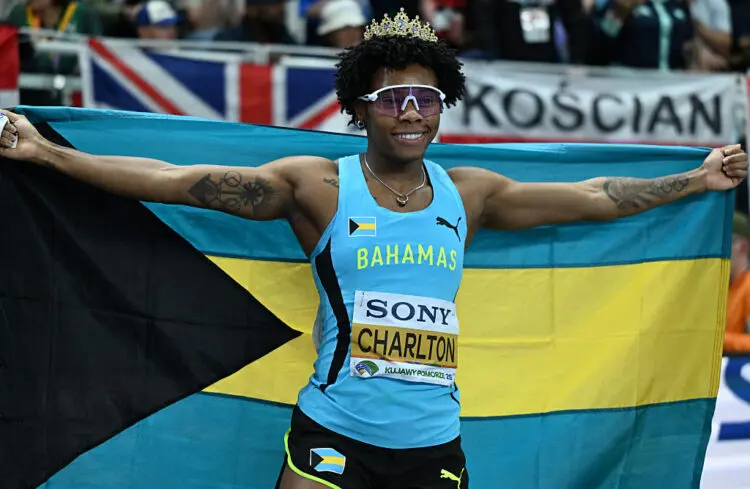
Devynne Charlton’s main target for the year might have been winning her third world indoor title, but landing gold in the 100m hurdles at the Commonwealth Games was significant, too.
“It’s huge,” she says. “My first outdoor title and a little peek into what's to come.”
Yes, the Bahamian concedes that she is better over the 60m hurdles – she is the world record-holder after all – but she is also refusing to be typecast as “just a 60m specialist. It’s something I'm actively trying to fight back against.”
Winning in Glasgow with a windy 12.33, beating Nigerian 100m hurdles world record-holder Tobi Amusan on the way, was certainly a good way of stating her case, but there is further evidence to back up her argument. The 30-year-old had won silver in the previous Commonwealth Games, as well as reaching three world and two Olympic finals, while her outdoor form in 2026 was also good. At the time of writing she had enjoyed four podium finishes in Diamond Leagues and a season’s best of 12.37.
Her closest to a global outdoor medal had been fourth at the Budapest World Championships in 2023 but injuries have not aided her cause as she seeks to shake off the tag of indoor runner.
“In one sense I think it's a fair observation because my outdoor time and accomplishments are lagging when you compare them to indoors,” she admits. “Being a short, more powerful hurdler, my skills are more suited to indoor. At the same time there was also a little bit of bad luck in Paris [at the 2024 Olympics].
"I think I was in really good shape going into the outdoor season and I think I would have run into the 12.2s just based off how I competed indoors [Masai Russell won the title in 12.33], but ended up straining my hamstring a month before the Olympics. So instead of pushing on, I was more managing an injury and then again last year I was dealing with injuries. It's just a combination of things, but I do think I have a lot more room to grow when it comes to the outdoor event.”
There is a frustration on Charlton’s part as to how she is perceived and asks why, when a 100m sprinter who is not equally good at 200m is not belittled for it, she should be seen as inferior because she is better at 60m hurdles than the 100m hurdles?
“I think other things change when you tack on another 40 metres,” she adds. “I think some people are only good at the 100m and you bring them to 60m and they might struggle. Because the 100m hurdles is the premier event, I think that's where people's focus is. But I do both.”
Charlton points out that, due to reshuffling of the calendar after Covid, there have been three World Indoor Championships in three years, giving more emphasis to the shorter event. There won’t be one in 2027, however, so the Kentucky-based athlete is intrigued to see how her coach Rolando Greene will approach next year.
And, while Charlton has set herself apart indoors, the outdoor event is far more open, with the likes of Russell, Amusan and Megan Simmonds having won Diamond Leagues this year, while Switzerland’s Ditaji Kambundji is the current world champion.
“We don't have a Ryan Crouser or Grant Holloway, Sydney McLaughlin or Mondo Duplantis of whom you would say: ‘this is the undisputed greatest’. I think there are so many different hurdlers who have something to bring to the table and others who are on the cusp of breaking through and establishing themselves.
“I think that keeps a lot of people going and keeps things competitive and we push each other. Having to go against these ladies, knowing that whatever you get in a race, like you earned it, makes you work for every little bit that you get. But it is exciting. It is a challenge and I love to challenge myself.”
She also loves too that there is no one ideal build for a sprint hurdler.
“You can be someone short like Megan Simmonds, whose advantage is going to be working in between the hurdles because she's able to utilize her stride length versus someone who's tall like Danielle Williams, whose advantage is getting down off of the hurdles quickly. “Danielle doesn't spend a whole lot of time in the air over the hurdles and then you have a lot more hurdlers in between who are a mixture of both of those things. I think it's a cool part of the event that there's no one prototype”.
Charlton is proud of what she has achieved and believes she has settled one argument, at least.
“I had won two World Indoor Championships already, I'd broken the world indoor record, but I still felt like there was still some debate about who was the best 60 metre hurdler of all time on the women's side,” she says. “And so I just knew that getting that third championship would really set me apart from everyone else who had won the event. So that was the goal, to just be able to come away with this saying that I was the undisputed greatest indoor hurdler.”
But there is more work to be done. She expects to have another four years at the elite level and more outdoor medals are at the top of the agenda, now.
“I think with another Olympics coming up, two world champs and the Ultimate championship, being top three and top of the podium in all of those, that is my driving force right now.”