AW 45 years ago

It was a quiet year in terms of major championships, with the European Cup being the biggest international event.
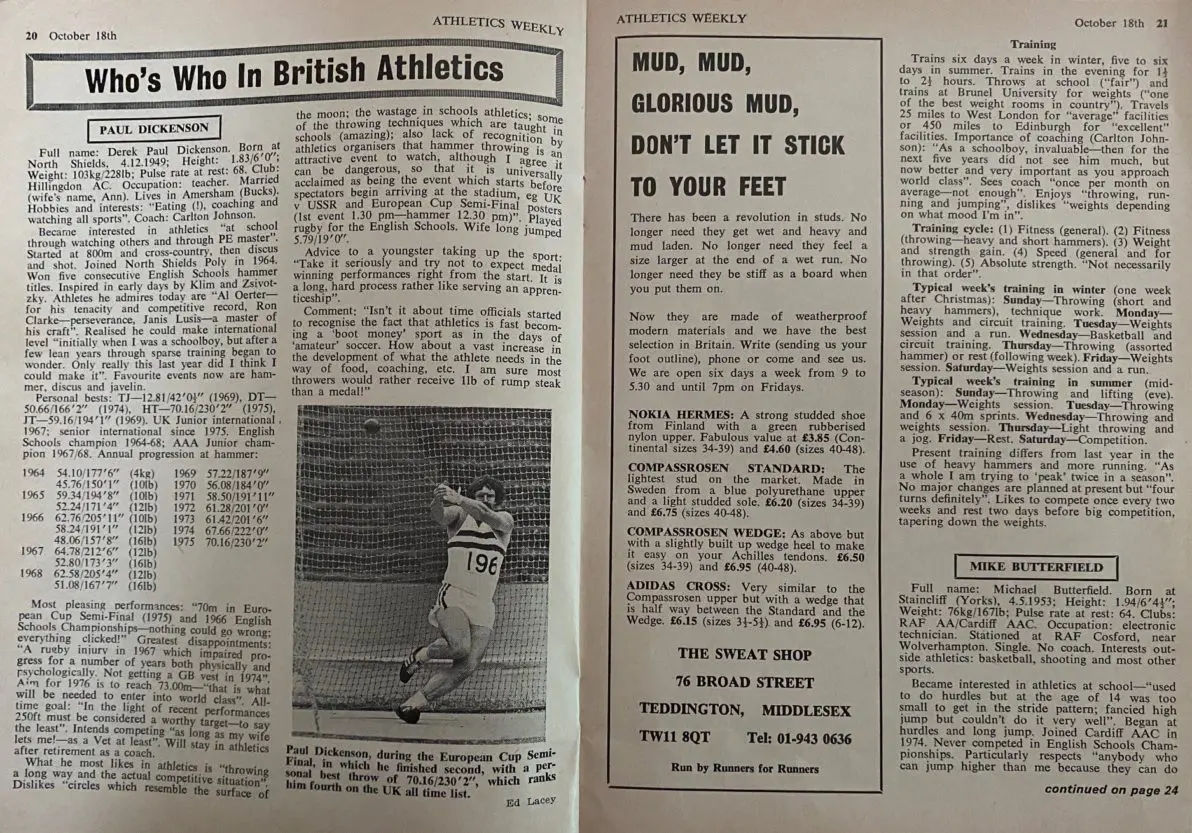
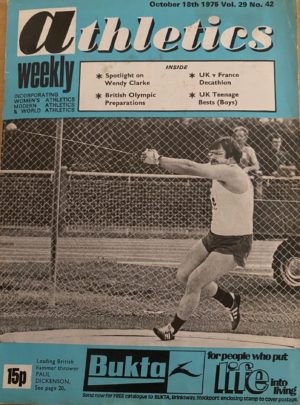 The issue we look at is October 18 and the cover star was Paul Dickenson, who is now probably better known for his BBC commentary career than he was for his hammer throwing.
The double Olympian had a PB of 70.16m when he was interviewed for 'Who’s Who in British Athletics' (page 20, below), but he went on to throw 73.20m the following Olympic year which still ranks him 20th all-time in the UK. It should also be noted that he now coaches 27 athletes according to Power of 10 and these include Jake Norris and Bayley Campbell and he also had a successful masters career.
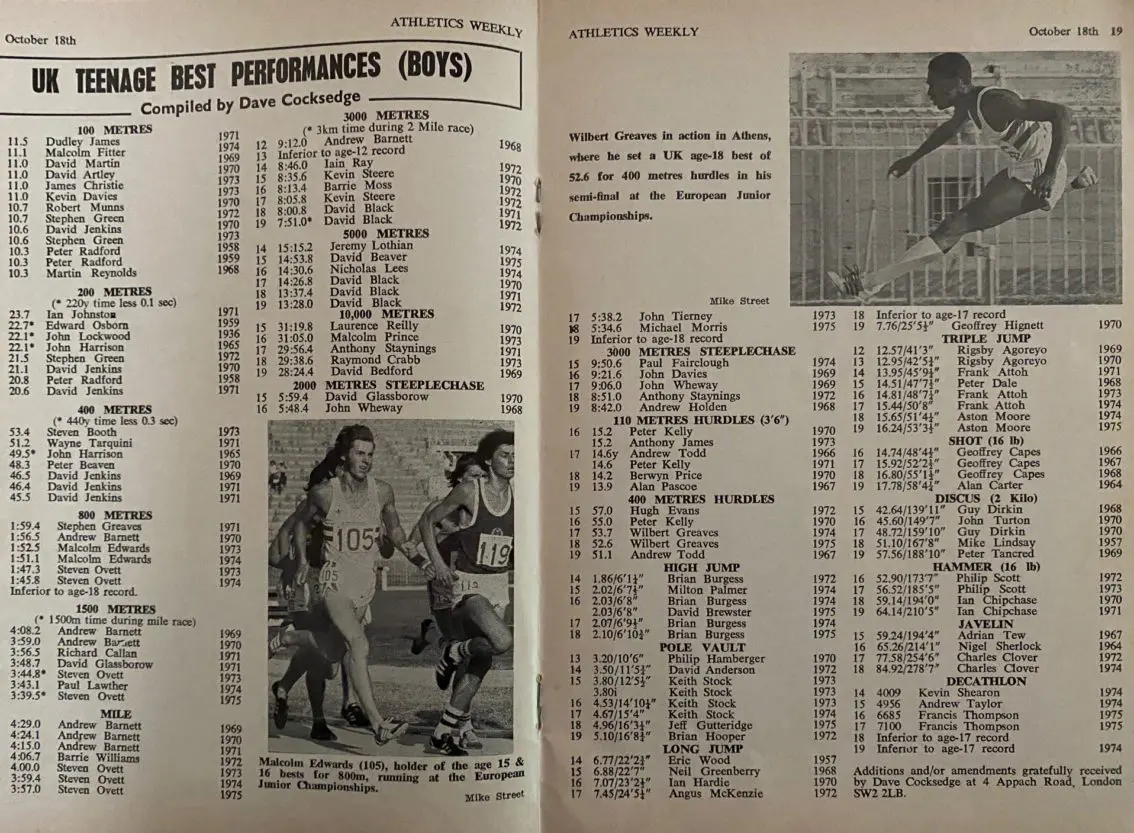
The most interesting pages for most might well be the UK teenage age best performances all-time on centre pages 18-19.
At the time the oldest marks (from 1958) belonged to 1960 Olympic sprint medallist Peter Radford (age 18 bests), who went on to head British Athletics.
Dave Jenkins, the 1971 European 400m champion, had six marks from 100m to 400m but that was headed by future Olympic champion Steve Ovett in the middle distances. All his 800m marks have fallen to current star Max Burgin and Steve Cram took most of his 1500m and mile marks.
 Ovett’s 1:47.3 (in the AAA final at 17) was a world age best at the time and his 1:45.8 age 18/19 gained him a European silver in the seniors.
He was not at his very best in 1975 but did set a mile record. Ovett had actually lost some of his younger marks to Malcolm Edwards whose picture appeared in the rankings.
Matching Ovett’s eight was Andy Barnett who was a sensation aged 12 to 15 and still holds some of those marks. He failed to fulfil his huge potential even as an older junior and never made his mark as a senior.
Dave Black, who won a Commonwealth 10,000m medal in 1974, held a lot of the 3000m and 5000m marks and note future 10,000m world record-holder Dave Bedford’s 28:24.4 which was a senior record at the time in 1969 and that is still the UK teenage record 51 years later.
Now top coach Aston Moore stands out in the triple jump while two other Commonwealth champions Geoff Capes and Charles Clover impress with their respective marks at the shot and javelin.
Daley Thompson effectively had four age records in the decathlon but was still to improve the age 18 and age 19 marks.
Page 6
Thompson’s age record is featured.
It said Thompson “produced his finest performance to date” to set a UK junior record in the UK v France Multi Events match in a UK junior record 7100.
His marks were 10.88w, 7.11m, 11.77m, 1.90m, 49.3, 16.0, 31.84m, 3.40m, 57.04m and 4:30.9 and he obviously showed great improvements on these marks on his senior career as he was a double Olympic as well as world and European champion and multi world record-setter.
Page 12/13
The other star athlete interviewed was double European junior sprint medallist Wendy Clarke, who at the time had PBs of 11.53 for 100m and 23.48 for 200m.
She was third in the 100m in 11.53 and second in the 200m in 23.85.
The triple sprint champion (11.34/23.20/44.05) at Athens was Petra Koppetsch of East Germany who did nothing as a senior but second in the 100m was Marlies Oelsner in 11.43. As Mrs Gohr, she became the first world 100m champion in 1983 and was second in the Olympics in 1980 and won three European titles and set a world record in 1982 of 10.88.
Clarke, under her married name Hoyte, became one of Britain’s most dependable sprinters as a senior, making European and Commonwealth finals and she won a European indoor 60m bronze medal in 1982, a year she also won a silver medal as part of Britain’s 4x100m team.
Page 2
The first result in the magazine was the Cutlers University Cross-Country Relay at Sheffield.
That was won by Loughborough with their Dave Moorcroft easily fastest with a record 8:39 which saw him move from sixth to first on leg four.
Moorcroft won Commonwealth golds in both 1978 (1500m) and 1982 (5000m) but his most notable run was a totally shocking 13:00.41 world 5000m record in 1982 which still ranks second all-time in the UK, 38 years later.
He was still parkrunning earlier this year before the lockdown.
Also in his team were Kirk Dumpleton, the only British athlete to win and defeat both Coe and Ovett in the same race (1972 English Schools cross-country), and former age record-holder Paul Williams.
In the Airedale team in second was John Temperton, who is now one of British Athletics top administrators.
Page 4/5
The Berwick Running of the Walls Race (6.75 miles) was won by 1970 International Cross-Country winner and 1969 European 10,000m silver medallist Mike Tagg, a whole 38 seconds up on an up and coming Mike McLeod.
Olympic steeplechaser and UK record-holder Andy Holden was third while now top coach Bud Baldaro was seventh.
ESAA champion John Mills (19:40) won the Youths 4 miles ahead of future internationals Nat Muir (19:53) and Tony Milovsorov (20:03).
10 years before his world record-breaking year, Steve Cram was second in the boys 2.5 mile in 14:08.
1972 Olympic 1500m runner and future London Marathon winner Joyce Smith easily won the women’s 2.5 mile, a second slower than Cram over the same course!
The day before in the Morpeth races, Mcleod had won the 6.75 miles in 32:43 while Cram had won the boys mile in 11:31.
Page 7
Six years before organising the first London Marathon, Chris Brasher won the Ranelagh Harriers Page Cup 5M handicap in 23:32 (taking 30:32 with his actual time) and the 1982 London winner and then junior Hugh Jones was fastest with 26:19.
Page 10
Brian Oldfield was voted the Pro Track athlete of the year, helped by his 22.86m shot record which was an astonishing metre further than the previous world record.
He only won $17.125 prize money that year on the Pro circuit that was then running concurrently with the official amateur sport but the biggest money earner was 1974 Double Commonwealth champion Ben Jipcho who won $27,500.
Geoff Tyler, the current British Masters M70 shot and discus winter throws champion, won the shot in the Sheffield field events meeting with a 15.55m throw. He was also second in the discus (49.12m) and third in the hammer (42.68m).
This year (with lighter implements) he has thrown 13.11m for the shot and 43.56m for the discus.
Page 11
The Kosice Marathon was dominated by North Koreans with 1972 Olympian Colin Kirkham the leading Briton in sixth in 2:17:09, one place up on Waldemar Cierpinski who was to go on to win the following year’s Olympics.
Typifying the way things were organised back then, Norman Deakin made a solid British international debut in 22nd having been given nine days notice to prepare for the marathon!
Page 16
In the Sutton in Ashfield’s Young Athletes composite relay, Aldershot won from Birchfield, for whom Richard Partridge was their fastest.
Partridge is the father of top endurance runner now, Lily, who competed for Aldershot for most of her career but she has now joined her father's club.
Page 17
Dave Cannon won the Ben Nevis Fell Race in 1:29:58. Cannon later had marathon success with a 2:11:22 PB in 1980 and ran for Britain in the 1978 European Championships.
Croydon won the Walton Hewitt Jones Road Relay with 1970 Commonwealth marathon bronze medallist Don Faircloth their fastest with a 15:21 leg.
The Aldershot B team contained a 18-year-old Roger Hackney, eight years before he finished fifth in the first World Championships steeplechase. He ran 16:18 and his team-mates included now top endurance coach Mick Woods, who ran 16:10. Bob Holt of Hercules was fastest with 15:10.
Page 23
Brian Adams (not that one) won the Leicester 7 walk in 51:06 and then was the leading Briton in the Lugano Cup in sixth in 1:27:46. He went on to finish 11th in the Olympics and a walks coach and competed last in 2017.
Page 25
In the British women’s league qualifying competition at Warley, Plymouth won from Wolverhampton.
For the latter future Olympic champion Tessa Sanderson won the javelin with 41.54m but also won the 100m hurdles in a windy 14.4.
European indoor 400m champion Verona Elder won the 200m and 400m in 24.7w and 55.1 while 1970 Commonwealth 800m champion Rosemary Wright won the 800m.
In adverts for shoes, the Adidas Cross was £6.50, the Adidas Country was £10.50, SL72 £10.50 and the Nike Oregon Waffle £11.75.
Union Jack Freedom Shorts were £1.90 and an Adidas Rain suit jacket was £5.99.
Page 28
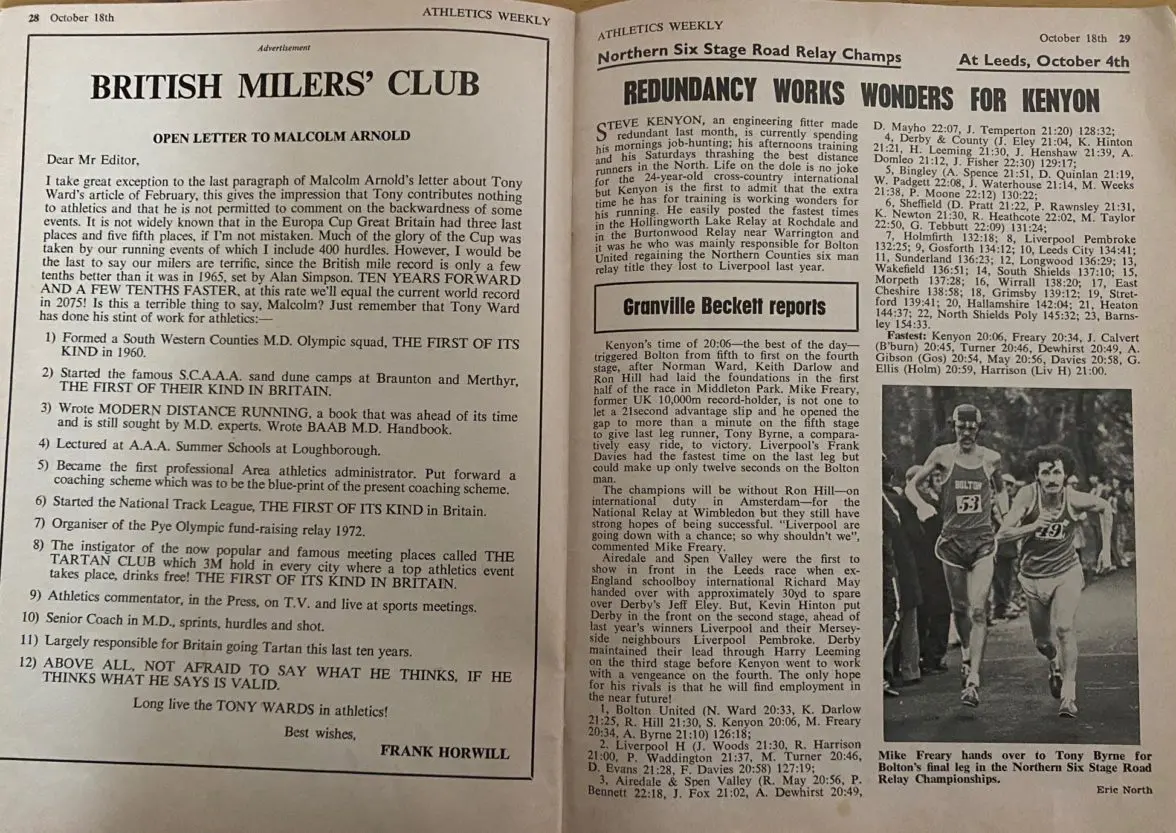
Frank Horwill took out a full page British Milers Club advert to come to the defence of coach, commentator and AW contributor Tony Ward, who had been criticised by top coach Malcolm Arnold.
Horwill stated: “I would be the last to say our milers were terrific, since the British mile record is only a few tenths better than it was in 1965, set by Alan Simpson. Ten years forward and a few tenths faster, at this rate we’ll equal the current world record in 2075!”
Things were to improve as from 1977 to 1986, British athletes won just about every major 1500m on offer as Ovett, Coe and Cram dominated.
Page 29
Bolton won the Northern Road Relays, featuring a picture of Mike Freary - former UK 10,000m record-holder and father of AW shoe guru Paul.
Ron Hill was also in the team as was fastest overall Steve Kenyon, whose 20:06 was 28 seconds better than next best Freary.
Page 30
There was a short interview with 1500m world record-setter Filbert Bayi, who was not impressed with new mile world record-holder John Walker.
“I do not see him as a threat to me at all. He has a poor finish.”
Walker won the following year’s Olympic final with a fast last lap.
Page 32
Verlea won the Southern Vets Cross-Country Relay at Parliament Hill with their team including John Steed, who was still competing last year as he approached the M85 age group.
In the Norfolk 15, Colin Moxsom won in 1:20:31 with fourth-placer Dave Cox (1:22:10) now heading the current UK M65 10km rankings.
Page 34
There is a letter of complaint about the lack of young athletes' results.
Ron Sales, the young Athletes League secretary, calculated that the October 4 issue was 21% adverts, 27% men’s results (including 8% walks), 19% articles, 10% letters, 10% miscellaneous including the cover, 8% women’s results, 4% photos and 0.59% youth and boys results.
Page 35
The AAA Special awards for 1975 were announced.
The outstanding athlete of the year award (CN Jackson Memorial Cup) went to Alan Pascoe, who was ranked second in the world at 400m hurdles with 48.59.
 The best champion (Harvey Memorial Cup) and best track performance by a UK athlete (Carborundum Golden Jubilee Trophy) went to Dave Black, who won the 10,000m title in 27:54.2.
The best under-21 performance at the AAA (Pepsi-Cola award) went to Steve Ovett, who retained his 800m title in 1:46.1.
You could get action colour posters (33x16” of Filbert Bayi, Kip Keino and John Akii-Bua for 99p) from Mark Shearman.
Page 36
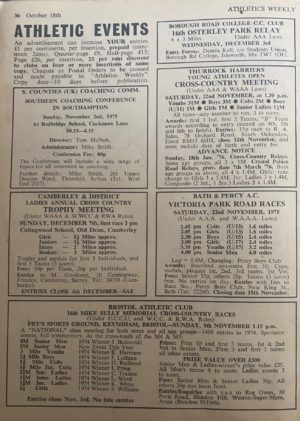
Entries to the Thurrock Harriers Cross Country meeting cost 15p an entry and Bath's Victoria Park Road Races 35p for seniors and others 20p while an all day coaching course with Tom McNab the director cost 80p.
Click here to read 'AW 50 years ago' reflecting on the October 3, 1970, edition of Athletics Weekly.
» For more on the latest athletics news, athletics events coverage and athletics updates, check out the AW homepage and our social media channels on Twitter, Facebook and Instagram