'I was complete': Roger Black on the race that defined his career

As part of AW’s Legends series, Tim Hutchings speaks to the multiple 400m champion about his lengthy career.
AW’s Legends Series shines the spotlight on some of the biggest stars ever to have competed on the track and in the field. The in-depth video interviews will educate and inspire you as each legend takes us through their personal journey in the sport.
Roger Black is one of Britain’s most recognisable names in athletics, having excelled over 400m. Individually, he won Olympic silver behind Michael Johnson at the 1996 Games in Atlanta, narrowly missed out on world gold in 1991 and secured two European and one Commonwealth victory. He also enjoyed success in the 4x400m relay, winning Olympic silver and bronze as well as three European titles and one Commonwealth gold. There were two world titles as well, the most recent coming in 1997, but most famously he combined with Derek Redmond, John Regis and Kriss Akabusi to upset the odds and defeat a formidable American line-up in Tokyo in 1991.
Since retirement Black the now 60-year-old has worked in the media and motivational speaking, joining forces with fellow Olympian Steve Backley to found the busines BackleyBlack. His daughter, Isabelle Black, is due to compete for France over 400m at the European Championships in Birmingham.
What’s the one race from your career that you’re most satisfied with?
It’s the Olympic silver in 1996 for so many reasons. Firstly, I could easily not have been there. I'd had knee surgery a few months earlier and I was hanging on at the end of my career. I think the greatest challenge of all for an athlete in the Olympics is to walk into the the Olympic [400m] final, have a plan and stick to it. Many times I didn't stick to a plan but in 1996 I'd mastered my trade and [even] with the distraction of Michael Johnson and [being in] the lane outside him in the Olympic final and all that, I felt peace. I couldn't have run any better and that for me was the best race of my career. I was done then. I was complete.
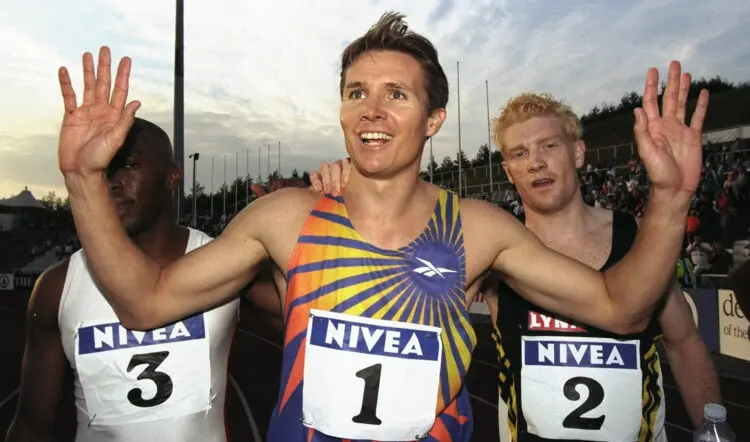
You were European Junior champion in 1985, then European and Commonwealth champion in 1986. It seemed to come naturally to you but then you had some difficult years later in the decade. What happened?
In '85, '86, you're not thinking about it. You're young, you're talented, you're healthy, you just get better every race. You just you're just running and hanging on and that was good enough to be the Commonwealth champion. That was good enough to be the European champion, and then I broke my foot, and the day I broke my foot was the day everything changed because suddenly something that was so easy was never going to be easy ever again. It was never easy again, and I had to reinvent myself. I had to learn. I had to try and understand the event and master the event, and it didn't happen quickly, but it culminated in 1996.
You grew up in Gosport down near Southampton, you were a good rugby player at school. and bright academically. You had the possibility of a medical career. How did you get into athletics?
I knew from a young age that I was faster than most people because it was obvious at school. I played rugby at school and I had a trial for England at 16, but I found out then that I was just fast. I wasn't a good rugby player. But I loved sport. I played Sunday League football, rugby, cricket, I tried anything.
I became an athlete because I messed up my A levels. I was going to go to university to read medicine, and had to get three Bs back then. I got an A in biology, I got a B in chemistry and I messed up my maths. I was devastated but I realised it was the best thing that ever happened to me.
My friend – a high jumper called Fayyaz Ahmed who I’d gone to English Schools with – was my biggest fan and said: ‘You don't know how good you are. You’ve got a year off to retake that exam. Go and train with Todd Bennett and Kriss Akabusi in Southampton. I went along in my rugby kit and my Green Flash trainers. I remember going in. I'd seen these guys run at the Olympics, and I couldn't believe it. I just got in there, chased them every day, and just kept chasing them. Early on, Kriss took me to one side and said: “You’re different.”
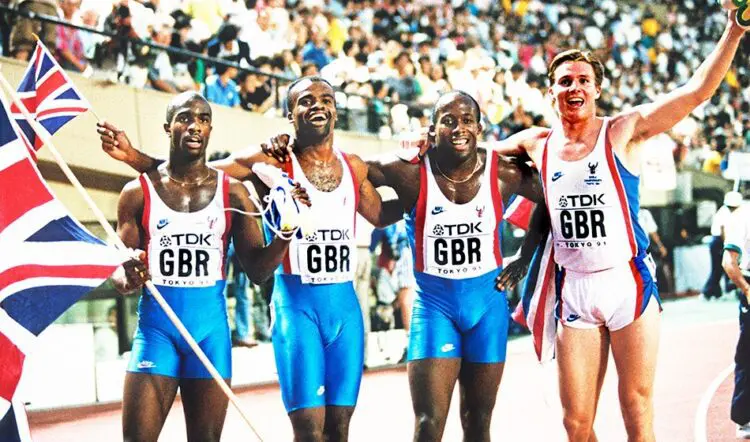
The 4x400m win at the 1991 World Championships is one of the most iconic moments in British athletics history.
I loved the relay. It was my natural environment. I was always happy being part of the team, and I understood that athletics is a team sport, even though you're the individual out there running, because we all have people around you to get you there.
The running order [for the final in Tokyo] was chosen the night before, and I was the best runner on the team, so I was going to go last. That's what you always did. But myself and Kriss went to bed that night, talked about it – John and Derek were doing the same – and we realised that we couldn't beat the Americans unless I went first, because we had to be in the lead, otherwise they would have gone too far away. So we reversed it.
I went first, which changed the whole race for them mentally as well because suddenly they're chasing. We put Derek second to keep us in contention and then John, of course, wasn't a 400m runner, but was the British record-holder over 300m. Kriss timed his run to perfection, while [US athlete] Antonio Pettigrew was complacent. It was extraordinary. It was the script of all scripts.
Your daughter is now an athlete and moved from Montpellier to train in the UK?
She's half British, half French and now living in Britain, training with my good friend Tony Lester and his training group. If you want to run fast, you've got to run with fast people and now she's at a level where she can dream of going to the Los Angeles Olympics.