17 Brits make top 10 in their events in 2017 world merit rankings

Mo Farah is among top world-ranked athletes

A total of 17 British athletes feature in the top 10 in their respective events in the 2017 world merit rankings.

According to statistics published in the latest edition of Athletics Weekly magazine, 17 Britons are ranked in the top 10 on merit this year, which matches the figure for 2016 and is an increase on the 14 in 2015.

Two athletes – Mo Farah and Laura Muir – are ranked in two events.

The December 21 edition of AW is a bumper 88-page special featuring statistics including these rankings based on "merit", which provide particularly interesting reading. Season's bests, championship performances and head-to-heads are all considered, with the rankings meticulously prepared by Peter Matthews and Mel Watman from Athletics International.

As well as Matthews and Watman, the selection panel included Stan Greenberg and Stuart Mazdon (UK), Mirko Jalava (FIN), Alfons Juck (SVK), A Lennart Julin (SWE) and Ed Gordon (USA).

Farah is Britain's sole top world-ranked athlete this year according to the merit lists. The 10-time global gold medallists bows out of his track career with his fifth top ranking at the 10,000m.

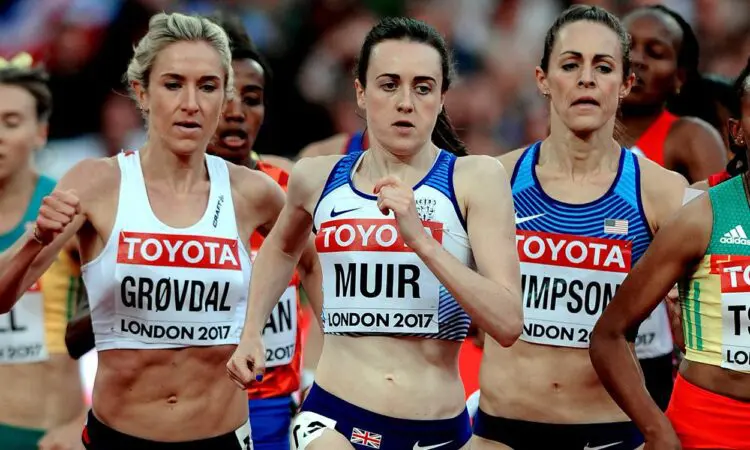
He also rates second in the world at 5000m, while Muir also features in two events and is ranked third at 1500m and 10th in the 5000m.

Laura-Muir-1500m-heat-London-2017-by-Mark-Shearman

The next highest ranked Britons are Holly Bradshaw, who ranks fourth in the pole vault, and Lorraine Ugen and Katarina Johnson-Thompson, who rank fifth in the long jump and heptathlon respectively.

Ranked sixth are Chijindu Ujah (100m), Robbie Grabarz (high jump), Nick Miller (HT), Dina Asher-Smith (200m) and Morgan Lake (HJ), while Nethaneel Mitchell-Blake in the 200m is among the athletes ranked seventh in their events.

Lynsey Sharp ranks eighth in the 800m, while Sophie Hitchon in the hammer throw and Laura Weightman in the 1500m rank ninth. Muir ranks 10th in the 5000m and also gaining that position in their events are Andrew Butchart (5000m), Andy Pozzi (110m hurdles) and Shara Proctor (LJ).

The latest edition of AW also includes UK merit rankings, compiled by Matthews. Mo Farah tops these rankings in the 5000m, 10,000m and 10 miles – half-marathon, while Callum Hawkins leads the men's marathon rankings.

Although of course well short of marathon standards set in the 1980s, 17 men broke 2:20 and 43 men broke 2:25 (best since 1995), which is up from 15 and 38 in 2016. A 10th best of 2:17:10 was the best since 1997.

The rankings also highlight other events that are flourishing in the UK, such as men’s and women’s sprints, while statistics identify the changing of the guard in disciplines like the women’s javelin and 400m, with Goldie Sayers and Christine Ohuruogu sliding off the lists.

AW-Dec-21-2017-cover-150This is just a selection of some of the stats included in the December 21 edition of AW which is available to buy online here, or read digitally here.

» The world merit rankings selection panel consisted of the co-editors of “Athletics International”, Peter Matthews and Mel Watman, with Stan Greenberg and Stuart Mazdon (UK), Mirko Jalava (FIN), Alfons Juck (SVK), A Lennart Julin (SWE) and Ed Gordon (USA). The panel assessed the year’s records of the leading contenders and the ranking order was determined by consensus. For more information on receiving the Athletics International newsletter email [email protected]

Happy Christmas from AW!

We wish our readers a wonderful Christmas time and a happy and healthy 2018!

However you will be spending your Christmas Day, we hope you enjoy the festivities.

Click here to read about the Christmas Day plans of some of Britain's top track and field stars.

AW-Dec-21-2017-cover-150The latest edition of Athletics Weekly magazine is our annual stats special, with 88 pages of rankings, interviews, news, performance features and more. Not got a copy but keen to have a read over the festive period? Check out our digital edition, which is available here.

The next issue of Athletics Weekly magazine is out on January 4.

We wish you a merry Christmas and a happy and healthy 2018!

Athletes share their Christmas Day plans

Will athletes be training or resting this Christmas Day? We asked some of Britain's track and field stars

British 100m and 200m record-holder and world and Olympic relay medallist Dina Asher-Smith
"I won’t be training on Christmas Day, but I will be on Boxing Day.

"I love spending time with family and I will enjoy my day with them, but we normally have track on Tuesdays and Boxing Day is a Tuesday so..."

2:09:49 marathoner Dewi Griffiths
"The last couple of years my usual routine has been to do a long run in the morning before eating my body weight in food and spending the rest of the day with my family.

"This year, due to my hamstring issue, I won’t be training and will enjoy the day eating good food and being with my family."

Olympic finalist and European indoor 3000m medallist Eilish McColgan
"Spending Christmas in Doha is a little different as it's obviously not a holiday that is celebrated over here so it's pretty easy to continue training - gyms and tracks are all open. But with Christmas falling on a Monday I'll be sticking to my normal training programme and going for an easy 5-mile run.

"I'll get that done in the morning whilst everyone's asleep and then enjoy the rest of the day with my family. My two little brothers, my mum and her husband John all run too, so we will probably have a group run in the morning before the festivities begin!"

BUCS champion and English National and Inter-Counties cross country runner-up Alex Teuten
"Christmas Day is a Monday so it will be my usual Monday double run day; typically 7 in the morning and 6 in the afternoon. The latter may be a bit slower seeing as I’ll be laden with Christmas lunch with the family!

"It will be a big gathering of us as usual; 16 of us this year."

British pole vault record-holder Holly Bradshaw
"Christmas Day and the whole Christmas period for me is all about family. I spend so much time away from them throughout the year, the least I could do is spend the most special time of the year with them.

"I will be having Christmas Day off training for sure, the one day of the year pole vault can take a back seat in my mind. Pole vault means the world to me but so does my family and Christmas is about them and creating amazing memories with them."

Paralympic, world and European champion and multiple world record-holder Hannah Cockroft
"I'm actually spending Christmas Day in a wood cabin in Lapland! No presents and definitely no training, just lots of food and my family.

"My brother lives out there and we've talked about spending a Christmas there every year for the last four years but training commitments have never allowed it. Finally, with a fairly quiet competitive season next year, we've made the trip."

World 4x100m champion and 200m fourth-placer Nethaneel Mitchell-Blake
"My Christmas Day plans are to spend time with family and enjoy the food.

"I’ll probably do a training circuit but that won't take up too much. It’ll be a day mostly spent with family and watching sports."

Paralympic and world medallist Stef Reid
"Christmas Day will be just my husband Brent and I. The way that our work and competition/training schedules worked out this year, we didn't have much time together. So we will probably sleep late, eat Christmas dinner, then we will see friends in the evening for a Christmas tipple and tea!

"I will 'exercise' on Christmas Day, but I won't train. I love to move, I love to feel my heart pounding. It is nice to have a break from speed endurance workouts and simply run because it makes me happy!

"We try and do as many fun things with friends and family as we can at Christmas. It is the one time of year our holiday schedule matches everyone else. Athletes can't do very much during the summer holidays!"

Olympic sixth-place 20km race walker Tom Bosworth
"If it's a normal training day then that's what I will do. This year Christmas falls on a Monday, usually two walks and gym, however with no gyms likely to be open I imagine coach will stick me down for something like 10-15km to do in the morning. Then sit back and enjoy the day.

"It's one of the few a year I get to spend with family, that’s just as good for you as going training! A bit of normality."

World marathon 13th-placer Charlotte Purdue
"I've just raced in Japan and I’m not arriving back in the UK until late on Christmas Eve, so my plans for Christmas Day are to sleep and recover!

"I’m going back to Australia after New Year so I’m spending the time over Christmas this year relaxing before a big block of hard work begins."

Multiple European Cross and track medallist Emelia Gorecka
"As Christmas Day falls on a Monday, I will be doing one or two easy runs, which is reflective of a typical training Monday for me. I may even squeeze in a recovery nap, tactically placed after our Christmas dinner! But the main focus of my day will be spending time with my family, cooking lovely food and playing board games!"

World 4x100m champion and overall IAAF Diamond League 100m winner Chijindu Ujah
"My Christmas Day plans are as always to spend time with the family and tuck into a nice big turkey! And maybe have a glass of champagne.

"I'll take 2-3 days downtime but my body and mind don't like much time off as I've got a routine going. It's definitely good to take some days off and spend time with family though, as I have been based in the States.

"I'd like to wish all Athletics Weekly readers a Merry Christmas and a Happy New Year!"

» Let us know if you’ll be training this Christmas Day – sent us a tweet @AthleticsWeekly, pop a message on Facebook or reply beneath this post!

» Whether you will or won’t be training this Christmas Day, you can still read about it! Check out our dedicated performance section online here

Nigel Levine alleged to have failed drugs test

The British sprinter has reportedly tested positive for banned substance clenbuterol

British sprinter Nigel Levine is alleged to have failed a drugs test.

According to The Daily Mail, the 2014 European 4x400m champion and three-time world indoor relay medallist is alleged to have tested positive for the banned substance clenbuterol.

Levine is yet to comment on the claims, while UK Athletics (UKA) has declined to comment at this time.

The 28-year-old was recently retained on UKA's World Class Performance Programme for 'Olympic Relays' level support. This followed the progress Levine had made after being involved in a serious motorbike crash while on a warm weather training camp in Tenerife in January.

When the funding lists were announced in November, British Athletics performance director Neil Black had said: "Nigel’s recovery from that accident is at an advanced stage in terms of his ability to compete again. As such we are able to retain him on the WCPP in his capacity as a relay athlete."

Clenbuterol is used mainly to treat asthma and other breathing disorders but is also deemed to have performance-enhancing qualities.

The Daily Mail reported that it is understood that Levine is awaiting the result of his B sample.

As well as his European and world indoor relay medal success, Levine has formed part of the GB 4x400m squad at two Olympic Games, including having raced as part of the team at London 2012.

Running shoe buyer's guide

Advice on how to find the right footwear for you

When I started to run around 40 years ago, the selection of running shoes available was rather limited. The models on sale were also very much ‘variations on a theme’.

Nowadays there is a dazzling array of brands and models available, each one suitable for a particular surface and type of running gait.

In this guide, I aim to explain the differences in various models and how to go about finding the best shoe for your feet and running style.

However, just as with running, reading about it will only get you so far. So, armed with the knowledge from within the guide, visit your local running specialist, try the shoes and see for yourself.

Paul Freary
Product Reviewer, Athletics Weekly
@runningshoeguru

Inside the guide you'll find:

» Advice on how to find the right footwear for you
» The best trail, support, neutral and racing footwear options
» An interview with two-time Olympian Lynsey Sharp
» A feature on shoe evolution
» A look at how the marathon world record has progressed in recent years

Read and download our running shoe buyer's guide here

AW-Nov-30-Adidas-Shoe-Guide-cover-200

Danny Talbot wants to find that winning attitude again

World champion sprinter determined to use relay confidence as a foundation for landing individual honours

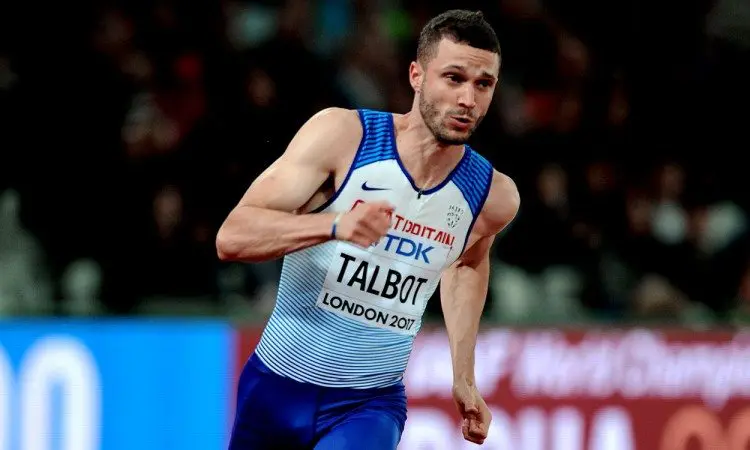
Danny Talbot is looking to harness the world-beating self-confidence he experienced as part of Great Britain’s 4x100m relay team and use it to deliver individual success in future.

The 26-year-old, who ran the third leg of the European record-breaking World Championships winning performance in London during the summer, found a level of certainty that meant he expected success when it came to the team event.

Now he wants to take that mental attitude into his own 200m event during a year in which there will be medal-winning opportunities at the Commonwealth Games in April and the European Championships in August.

Talbot experienced something of a rollercoaster at London 2017, breaking his 200m personal best by running 20.16 in the heats and holding his own against Wayde van Niekerk.

Disappointment then followed when he was knocked out in the semi-finals before, just a few days later, he combined with CJ Ujah, Adam Gemili and Nethaneel Mitchell-Blake to become a relay world champion.

"Now my aim is to be able to perform better at the championships in the 200m"

“The relay was amazing but I’m an athlete who thinks my relay helps my 200m and my 200m helps my relay so now my aim is to be able to perform better at the championships in the 200m,” says Talbot, who is coached by Benke Blomkvist, one of the masterminds behind the relay win. “I did run a personal best so we did get the timing of our training right but I wasn’t able to repeat that performance when it came to the semi-finals.

“Whether that’s something we need to do in training or whether that’s something I need to work on psychologically… I think that probably is the case.

“There was no doubt in mind we were going to win the relay and I had that feeling throughout every relay race we had that season. I went into that race believing I was going to be a world champion at the end of that, so I think I can take that into competitions and championships in future.”

Danny-Talbot-London-2017-by-mark-Shearman

He adds: “I’ve been doing a lot of work with a sports psychologist Jen Savage and I want to make sure I can get to a championship individually and perform well.

“In terms of training, Benke is always trying to adapt things and make me better, so that I can replicate good performances and come away with medals.”

As for his fellow sprinters, Talbot insists now is the time for them all to add to their own personal honours lists.

“Individually I think we all need to step up,” he adds. “We’ve come very, very close to getting medals in the 200m, with Zharnel (Hughes), Adam and Nethaneel but I know those guys, myself and all the 100m guys, we want to step up and win global medals.

“For us the Commonwealth Games is a massive opportunity. Hopefully we can medal there individually, take confidence into the European Championships medals and build on that.

“We’ve shown we can beat the best as a team, but now we need to believe we can do it individually. I think, once we do that, we are potentially the best sprinting nation in the world.”

"Individually I think we all need to step up"

Talbot also harbours ambitions for further relay success and insists he and his British team-mates have room for improvement.

“It’s going to be pretty hard to top it,” he says of that memorable night at the London Stadium, where the British line-up clocked 37.47.

“However, I think we can run faster. If you were to look at it and really critique it then we’re capable of going faster. Other than CJ’s first leg, I think the other three of us have all run faster than our split times for the final so it shows that we can top it in terms of continuing to win gold medals. We can hopefully try to become Olympic champions. There are other teams who obviously want to beat us but if we continue to do what we do and try and improve ourselves then hopefully we can go faster.”

» Read the inside story of Great Britain’s relay gold medal success in the latest issue of Athletics Weekly, out now and available digitally here

Alan Pascoe, a master of his trades

Alan Pascoe is a trailblazer, having driven advances in the athletics and business worlds. Jessica Whittington sat down with him and his wife, fellow former athlete Della, to hear their thoughts on the sport's past, present and future

When someone with the stature of Alan Pascoe offers advice – “Take chances as they come, work hard and make your own luck” – you would do well to take it.

One of the most influential figures in British athletics – he’s twice put the sport back on a sound financial footing when it had nothing – there are not many people who have worked harder to benefit the sport than Pascoe and the former hurdler’s successes far transcend track and field.

But his athletics journey is fascinating and his route from “a council house kid who had quite severe childhood asthma” to an Olympic, European and Commonwealth medal-winning athlete is proof of what can be achieved with the right mindset, no little effort and coaching support.

It was athletics, too, which opened the doors to his business career.

“I’ve said it as I was sat at the table in many important and influential places and meetings all around the world, including Buckingham Palace – I wouldn’t be here now if it wasn’t for athletics!” Pascoe explains. “And I wouldn’t have been in athletics at that level if it hadn’t have been for Doug.”

The beginning

The ‘Doug’ in question is Douglas James, the father of Pascoe’s wife Della and the man who coached them both to great success.

As I am welcomed into the magnificent Thameside home of the Pascoes, which was once owned by Dave Gilmour of Pink Floyd, Della reflects on their early athletics days.

“Alan and I met at the running track in Portsmouth. I had to slow down for him to catch me,” she smiles, reminiscing on 53 years earlier when she was 15 and Alan 17.

“When I look back now I think we couldn’t have been fitter,” she says, a result of her father’s coaching. “He used to have us jumping over walls and in the stadium we’d go running up the steps, jumping over the barriers. It was very hard but we all used to do it all, and we were all really fit. That was the ground rules of his training – the fitness aspect.”

So which qualities did James instil the most? “Discipline, commitment, focus and confidence,” replies Alan, and it is clear he has not restricted those characteristics to only his track career.

Della-and-Alan-Pascoe-2017-by-Jessica-Whittington

Track success

After claiming European 110m hurdles bronze in 1969 to go with his European indoor gold from the winter before, he went one better to secure 110m hurdles silver two years later before winning double gold in the 400m hurdles and 4x400m in Rome in 1974.

Earlier that year he had added Commonwealth 400m hurdles gold and relay silver to his haul and followed that up with 400m hurdles bronze four years later. His Olympic silver – claimed alongside Martin Reynolds, David Hemery and David Jenkins – came in Munich in 1972. Alan also won a total of 13 AAA titles, including doubles in the 110m hurdles and 200m in both 1971 and 1972.

So what was his competitive career highlight?

“Every time I won,” he says. “Because, for a long while, it was quite a surprise to me!

“I guess the real highlight would be winning the Europeans on the back of winning the Commonwealths. We won the relay as well. It was just fun doing it. Competing made up for all the grind on the training track.

“I was never somebody that trained very well, especially in winter. Hill work, high numbers of reps and turnabouts were not my thing – I suppose the asthma heritage accounted for most of that!”

Turning to her husband, Della, who adds that her own highlight was equalling the British 100m record as a 19-year-old in Mexico in 1968, says: “You were a competitor, that was your strength. You could overcome anything because you were so strong mentally.”

While Alan’s career would continue through to 1978, two-time Olympian Della (pictured below, second from left) retired just four years after her record-equalling run.

“I stopped running in 1973 because I didn’t make it on to the Commonwealth Games team, despite finishing in the top three in both sprints at the trials,” she explains.

“Della also suffered from the fact that I had been team captain and I was the athlete’s representative on the British Amateur Athletic Board,” adds Alan. “I don’t think I was particularly outspoken, I just said it like it was. I tried to represent the athletes and improve their lot. The management in those days was pretty poor to say the least and I was seen as a rebel or a troublemaker by the powers that be but I was an automatic selection, so they couldn’t get at me. It was Della that suffered! Unfortunately, that’s what we had to contend with in those days.”

Della-Pascoe-1968-by-Mark-Shearman

The business of athletics

While he was still competing, Alan – who was also a teacher at Dulwich College from 1971 to 1974 and a lecturer at Borough Road College in Isleworth from 1974 to 1980 – became involved with broadcasting and “unwittingly” entered the world of sponsorship, sports marketing and managing events.

A pioneer of UK sports marketing, he went on to create Alan Pascoe Associates Ltd (APA), later named API, and Fast Track, which became CSM Sport and Entertainment and a division of Chime plc.

From 1984 to 2012, Alan led APA and then Fast Track to raise over £100 million for the sport and put on more than 200 televised track and field events. He created new events, including The National Fun Run which was the precursor to the London Marathon, and was also at the forefront of the transformation of in-stadium presentation.

Alan is now a Trustee of the London Marathon Charitable Trust and Non-Executive Director of London Marathon Events Ltd, while he is also a Trustee of the ‘sport for development’ charity Sported.

"Take chances as they come, work hard and make your own luck" - Alan Pascoe

Della was also heavily involved with charity work and has raised almost £200,000 for the Princess Alice Hospice through events, including a series of popular garden parties, although her work has been curtailed somewhat since she developed Parkinson’s.

“We opened with a coffee morning and we made £477 but I thought we could do better than that,” she says as Alan smiles and replies: “Not competitive, of course.”

Vice-chairman of London’s successful 2012 Games bid, Alan also helped Glasgow successfully bid for the 2014 Commonwealth Games and most recently led the panel to carry out a feasibility study for Birmingham’s Games bid.

When it comes to what Alan is most proud of in his business career, aside from being a part of the 2012 winning bid, there is certainly plenty to choose from.

“Making a difference to a lot of sports,” he decides. “In athletics, putting on those early events and building on one or two experiences I had at events abroad, that we could put on far better events than the governing body was organising.

“At one of the last White City events, I remember the announcer saying, ‘next in the long jump: L Davies of Cardiff’. Well he was Olympic champion then. He was also my hero. So I was really p***** off. I didn’t have any background in event management then, but I knew that if you wanted to engage the fans and the people who paid their money to come in, they had to feel part of it: ‘Will you welcome our Olympic champion ... the great Lynn Davies!’

“So transforming the event presentation of track and field worldwide, which I was prompted to do by the then head of sport at Channel 4, Mike Miller. He said: ‘It’s not like watching football, rugby or basketball or virtually anything else. There’s five or six things going on all at the same time, I never know where to look at the right time.’

“Then we started experimenting with all sorts of presentation options,” Alan continues. “We upset the traditionalists because we started playing music and did track-side interviews. Every sport now does event presentation and have upped their game as a result of what athletics led.”

The future

Ultimately, Alan believes the sport as a whole needs to progress and recent comments from IAAF president Seb Coe about ideas designed to shake athletics up suggests the powers that be agree.

“It’s got to start with kids, you’ve got to welcome them into our sport,” Alan says. “Unless the national schools championships and everything just above it and below it are thriving, the sport is going to struggle.”

He adds: “I’m really concerned that the headway the sport made in the 15 years up to the Olympics in London has largely been lost. Without Mo (Farah) and Jess (Ennis-Hill) we have no individual medallists – you have to have ‘names’ to bring the paying public in, to inspire the next generations and to keep television interested. With less television you have less sponsor opportunity, and therefore less money coming into the sport.

“I know you can’t totally create these things but if I had been running the sport and looking at what we need I would have made sure that we had a programme for decathletes that matched the good fortune that we’ve had in the heptathlon ever since Mary Peters.

“Why do you need decathletes and heptathletes? It’s four days of television at the major championships and it’s the only time in athletics when you’ve got a natural story. Television is about big moments but it’s also about storytelling and it’s about how you engage with viewers.”

"I will be forever grateful for the opportunity athletics gave me" - Alan Pascoe

Alan himself clearly has a way of engaging with an audience. Sadly, it’s time for me to leave the Pacoes in peace, but not before hearing one last bit of advice.

“Over the years I’ve had lots of parents tell me, ‘my son/daughter is at national schools level (in various sports) and wants to carry on but I want them to get their A-Levels and go to university and I don’t think they can do both’,” says Alan. “I’d always say, ‘let them follow their sporting dream, they will keep up or catch up their education, but the experience they gain through top-level sport will be of greater value than their A-Levels’.

“One of the things that I learned as an employer was that there are plenty of people that got 2:1s or Firsts who wanted to work with us, but the ones you are looking for usually have a different quality – personality. Often, I took people that had been to art or drama school, or had reached the top level in sport – even if they didn’t have a 2:1! It was their understanding, focus, commitment and drive that counts.

“That’s why so many sports people do so well out there in the business world – because they’ve got the focus, they’ve got the dedication but they’ve also got the experience and the confidence because they’ve travelled the world and they’ve met so many significant people.

“I guess that personifies what happened to me, and I will be forever grateful for the opportunity athletics gave me.”

Birmingham to host 2022 Commonwealth Games

The Games will return to England for the first time since Manchester in 2002

Birmingham has been confirmed as the host city for the XXII Commonwealth Games in 2022.

Commonwealth Games Federation (CGF) president Louise Martin CBE described the awarding of the Games to the English West Midlands city as "a defining moment for this truly Commonwealth city".

The Birmingham 2022 Games – expected to take place from July 27 - August 7 – will mark 20 years since the last time the Games were held in England, in Manchester in 2002.

"With its rich history, cultural diversity, youthful dynamism and ambitious spirit, Birmingham embodies all that we cherish about the Commonwealth, and so the Commonwealth Sports Movement looks forward to collaborating with all the Games partners to showcase the city’s humanity and pride to a global audience over the coming months and years," added Martin.

The host city announcement was made at a special media conference staged at the Arena Academy school in Birmingham on Thursday morning.

The final Birmingham 2022 bid documentation had been submitted by Commonwealth Games England (CGE), the Department for Digital, Culture, Media and Sport (DCMS) on behalf of the UK Government, and Birmingham City Council, supported by the West Midlands Combined Authority.

Sports Minister Tracey Crouch said: "The UK has a brilliant track record for putting on the biggest sport events in the world and it is great news that Birmingham has been selected to host the 2022 Commonwealth Games. I am sure that we will put on an event that will make the country proud, leave a strong sporting legacy and strengthen relationships with our friends across the Commonwealth."

Birmingham’s bid included extensive renovation of the Alexander Stadium (pictured), where athletics plus the opening and closing ceremonies are set to be held.

An “enhanced and refurbished” Alexander Stadium is said to have been “pivotal” to the Birmingham 2022 Games.

Alexander Stadium is the home of UK Athletics and is host to an IAAF Diamond League meeting each year.

Alexander-Stadium-overhead-Birmingham-2022

Major athletics also returns to Birmingham next March as the city hosts the IAAF World Indoor Championships.

It will be the city’s second hosting of the event, having previously staged the Championships in 2003.

The Birmingham International Marathon will also return next October, along with the Great Birmingham Run.

Birmingham was confirmed as the UK’s official candidate city ahead of Liverpool back in September. The bid race had got under way earlier this year after South African city Durban lost the right to host the event.

On Thursday, Martin thanked Canada, Malaysia and Australia for their continued interest expressed in hosting a future Commonwealth Games, and confirmed that the Commonwealth Games Associations (CGAs) in these countries have signalled their potential hosting interest in either 2026 or 2030.

Looking ahead to Birmingham 2022, she said: "The vast majority of the Games venues are in place, and with extensive experience in the UK of hosting successful major events – including Manchester 2002, London 2012 and Glasgow 2014 – the CGF looks forward to a truly spectacular Games that delivers not only for the 2.4 billion citizens across the Commonwealth but the wider world, too.

"Today is a fantastic day for Birmingham, global Britain and our resurgent Commonwealth Sports Movement."

Ian Ward, leader of Birmingham City Council and chair of the bid team, said: "This is a wonderful way to end the year and celebrate the festive season – with an early Christmas present for the city! At the start of 2017 we were looking into the feasibility of hosting the Games in 2026, but when 2022 became a possibility in April, we made the decision to back ourselves even though we knew that we would need to do a lot of work in a short time frame. That work and belief has been rewarded.

"This has been a team effort and the bid team would like to thank everyone who has contributed.

"The hard work begins now and we all have just four-and-a-half years to deliver an unforgettable Games that will shape the future of our city, our region and our people. Thank you for backing Birmingham’s bid."

Gold Coast Games remind Andrew Butchart how far he's come

Scotland’s 5000m man takes stock on his whirlwind career so far as he prepares for his first shot at Commonwealth Games glory

Andrew Butchart doesn’t really remember taking in much of the 2014 Commonwealth Games, when they were staged in Glasgow. Without a place in the Scottish team, he was left on the outside and wasn’t even looking in as the home athletes rose to the occasion at Hampden Park and beyond.

The 26-year-old does, however, remember the aftermath of those Games, the levels of hype and interest they created and how he felt an immediate need to make sure of securing his place next time around.

Much has happened since then, of course, and Butchart has his seat on the plane bound for Gold Coast very much booked. He also has the small matter of a sixth-place finish in a 5000m Olympic final, eighth place in the World Championships final and a recently-acquired first individual honour in the shape of a European Cross Country Championships bronze medal to his name.

The coming of another Commonwealth Games is another major landmark which acts as a reminder as to how far the man from Dunblane has come in a very short space of time.

“In 2014, I thought I was good enough to run the 1500m, but I wasn’t,” grins Butchart. “But that was the year I ran 5km on the track, in Oxford, broke 14 minutes and it made me think ‘oh, I’m pretty good at the 5km’.

“I can’t actually remember watching it (Glasgow 2014) on TV, I think I neglected it. I don’t really remember it that well but I definitely remember after the Games and thinking: ‘This is massive. I NEED to get to Australia, I NEED to get to the next Commonwealth Games’.

“Now I’m here and it’s amazing how things have changed in such a short time. As I say, I only ran my first 5km in 2014, and now I’m looking for a medal.

“There’s a saying that ‘good things happen over time but great things happen instantly’ and I guess, with me, everything happened so, so quickly, especially in 2016 which was mad.

“It feels like Rio was yesterday, and now we’re looking at a Commonwealth Games and I did a World Champs in between all that. I need to enjoy it, to enjoy the preparations for this one, and then go out and perform.”

"I need to enjoy it, to enjoy the preparations for this one, and then go out and perform"

Butchart’s name featured among the 25-strong list of track and field athletes recently announced for Gold Coast 2018 by Team Scotland. There is an undeniable importance placed by those selected on wearing the Scottish vest and indeed they will also be donning bespoke parade uniforms, made by tartan manufacturers House of Edgar and designed by Siobhan Mackenzie, which were unveiled this week.

Butchart admits it’s hard to put his finger on exactly why the Scots seem to put such an emphasis on the Commonwealths, but adds: “I always say it’s a snowball effect – somebody performs, then the next person performs and so on – but where the snowball started and why it started, I don’t know.

“I don’t know who started it – if it was Lee McConnell, Lynsey Sharp or Eilish McColgan or myself, Laura Muir, Callum Hawkins.

“I guess whatever happened just needs to keep going because I’m sure another name is going to pop up, then another name is going to pop up and we’ll all still be performing. So it won’t be like a super seven but perhaps 14, 20, 25 and before you know it we’re filling teams.”

Butchart recently moved out to California with girlfriend Lynsey Sharp to work more closely with coach Terrence Mahon in a move which he hopes will take him to greater heights.

Certainly, he has set his sights on following in the illustrious footsteps of the likes of Ian Stewart, Commonwealth 5000m champion for Scotland in 1970, whose Scottish two-mile indoor record he broke earlier this year.

“He won gold in Edinburgh in 1970 and I look back at those results because Meadowbank is being closed down,” says Butchart, who also holds the Scottish records for 3000m and 5000m and has announced he will run the shorter distance the Müller Indoor Grand Prix in Glasgow on February 25. “I look back at that and think ‘I need to win this race’. I met Ian Stewart a couple of years ago – he wanted to train me and coach me.”

Butchart, however, prefers to do much of his learning from his peers.

“Because I didn’t know much about the sport when I was young, I didn’t grow up being an athletics geek, the people I’ve learned a lot from have been the people I run with,” he says. “So I’ve learned a lot from Chris O’Hare, I’ve learned a lot from Lynsey Sharp, I’ve learned a lot from Mo Farah. I’m learning from the people in the sport just now.”

Study shows impact of 'Summer of World Athletics'

More than a million people attended the World Para Athletics Championships and IAAF World Championships in London

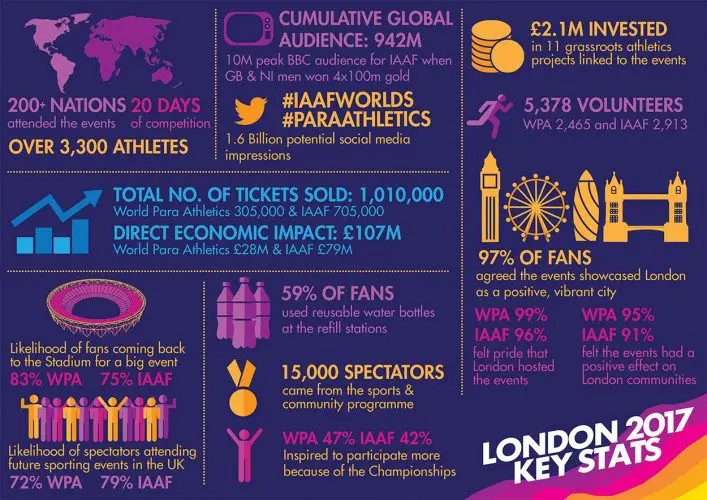
An event impact study has highlighted the benefits of London having hosted the 'Summer of World Athletics' in 2017.

The study, which is available to view at www.londonandpartners.com/events/news, was undertaken following the World Para Athletics Championships and IAAF World Championships London 2017.

London became the first city ever to host both the World Para Athletics Championships and IAAF World Championships in the same year with more than 3300 athletes from more than 200 nations competing in 30 sessions across 20 days.

The study, delivered by The Sports Consultancy, in partnership with Nielsen Sports, Gracenote and PCSG, assessed the total direct economic impact of the Summer of World Athletics as exceeding £107million.

More than a million people attended the Championships, with events not just held in the London Stadium but across the capital. The IAAF World Championships were awarded a Guinness World Record for tickets sold in excess of 705,000, while the World Para Athletics Championships, with 305,000 ticket sales, exceeded the figures for all previous editions of the event combined.

Infographic_London-2017

The report also showed that a £2.1million investment was made into grassroots athletics and running, with the official inspiration programme and ‘Team Personal Best’ engaging with 250,000 people through 733 events with 250 held in the host city alone. Further to that, an average 45% of those surveyed said they had been inspired to do sport or active recreation more often than usual as a result of attending the Championships.

Matthew Wilson, director of consulting at The Sports Consultancy, said: "This report clearly evidences the extensive impact the IAAF World Championships and World Para Athletics Championships delivered to London’s businesses and citizens. These events delivered a direct economic impact to London which significantly exceeds that generated by the previous editions of each event.

"Moreover, London 2017 delivered compelling evidence across a broad range of impact parameters, evidencing successful engagement of London communities, enhancement of London’s reputation as a global tourism, major event and business destination as well as a champion of diversity, and investment in sport participation - not just in London, but throughout the UK and internationally."

Shin splints: Causes and treatment

Shin splints can cripple an athlete. Here's some advice on reducing the problem

There's barely an athlete out there who hasn’t suffered from shin pain or shin splints at some point in their career.

Paul Hobrough, a physiotherapist and author of Running Free of Injuries (Bloomsbury, £18.99), says he sees “a tsunami of shin pain sufferers each year” and Matt Todman, director of the Six Physio chain of physiotherapy clinics in London, says it is among the most common problems he treats among patients.

In most cases, pain at the front of the leg will be diagnosed as ‘shin splints’, an umbrella term for multiple different possible diagnoses ranging from muscle DOMS (delayed onset muscle soreness) to tendonitis and periostitis.

What are shin splints?

Known medically as medial tibial stress syndrome (or MTSS), the condition causes pain on the lower, inside part of the shin bone and while it initially might feel painful during exercise, it can progress to feeling sore even during periods of rest.

“My belief is that we have become overly diagnostic in labelling some injuries and problems,” says Todman. “Shin splints are a case in point and you may have been given very complex-sounding names for pain in the front of your leg. Basically, it’s all shin splints.”

What causes it?

There are multiple causes and no case of shin splints is the same. “Risk factors have been shown to be increased BMI, poor alignment of the bones in the foot, a loss of plantarflexion (ability to point the toes) and a loss of hip rotation externally,” says Hobrough.

One or more of these biomechanical factors – or overtraining – contrive to overload the muscles of the lower leg. “Muscles need a chance to develop in size, strength and flexibility and most people who lift weights know not to do bicep curls every day,” Hobrough says. “Running is basically the same as working the equivalent muscle in the lower leg this way.”

How do you know if you have shin splints?

A painful spot on the inner edge of your shin is often a giveaway sign you have developed shin splints.

“The periosteum, the surface of the bone, becomes inflamed and tender as it’s constantly trying to repair the stress that repetitive activity places on it,” says Dr Juliet McGrattan, a GP and author of Sorted: The Active Women’s Guide to Health (Bloomsbury, £16.99).

If you feel pain over a few inches of your lower leg then it is likely shin splints.

McGrattan adds: “If the pain is in a very precise location, then you may need an X-ray to rule out a bone problem like a stress fracture.”

How to treat it

McGrattan says the PRICE technique – Protect, Rest, Ice, Compress and Elevate – should be used in the acute stages.

“Mild MTSS will improve quickly with rest," she says.

"As with any injury or pain, if you begin to develop shin pain, listen to your body and reduce or stop the aggravating activity,” suggests Hannah Zreik, the physiotherapy team lead at Bupa Health Clinics. “If the pain doesn’t go away after rest, see a physiotherapist.”

How to prevent it

Check your shoes – they can often be an underlying cause. “Other possible reasons are poor flexibility or poor core and lower body strength,” Zreik says.

Todman suggests practicing walking on your heels twice a day for three minutes at a time. “Do it barefoot around the house,” he says. “It really helps to strengthen the muscles in the shin area.”

» Matt Todman (Sixphysio.com); Paul Hobrough (physioandtherapy.co.uk); Bupa Health Clinics (bupa.co.uk)

» For more on the latest athletics news, athletics events coverage and athletics updates, check out the AW homepage and our social media channels on TwitterFacebook and Instagram

Christmas gift guide

Looking for some last-minute Christmas gift ideas for yourself or the athletics fans in your life? Products editor Paul Freary has some suggestions

Secret Link